[Ropac] Frieze Seoul 2025 Preview
![[Ropac] Frieze Seoul 2025 Preview](/art-research/archive/ropac-frieze-seoul-2025-preview-page-0004.webp)
Source text · Page 1
Frieze Seoul 3—6 September 2025 Booth C5
Source text · Page 4
Georg Baselitz, Ein Bein von Manet aus Paris , installation view, Thaddaeus Ropac, Paris Pantin, 2025. Georg Baselitz Schwer. Schwermut, 2025 Oil on canvas Frame 264 x 214 cm (103.94 x 84.25 in) (GB 2870) [金额已省略] (plus applicable taxes) Indisputably one of the most important artists of our time, Georg Baselitz has forged a unique artistic vocabulary over the course of his career, while also shaping an identity for postwar German art. Baselitz has constantly renewed his practice through formal innovation, drawing upon art history and his own extensive oeuvre, while never allowing himself to become restricted by a single, identifiable style. Schwer. Schwermut (2025) is a monochrome, full-body portrait of the artist’s wife, Elke. Paintings of Elke constitute the largest single group of Baselitz’s portraits, in which the artist engages with the complexities of representation and the inescapability of subjectivity. The thin, rounded lines of a metal bedframe – a rare suggestion of setting in Baselitz’s work – are echoed by expressive, textured striations that run over the painting’s surface. Ever the innovator, Baselitz uses his walking frame as a tool for mark-making: an embodied, physical approach that recalls the all-over canvases of Abstract Expressionism, as well as the techniques of Robert Rauschenberg and Joseph Beuys.
Source text · Page 8
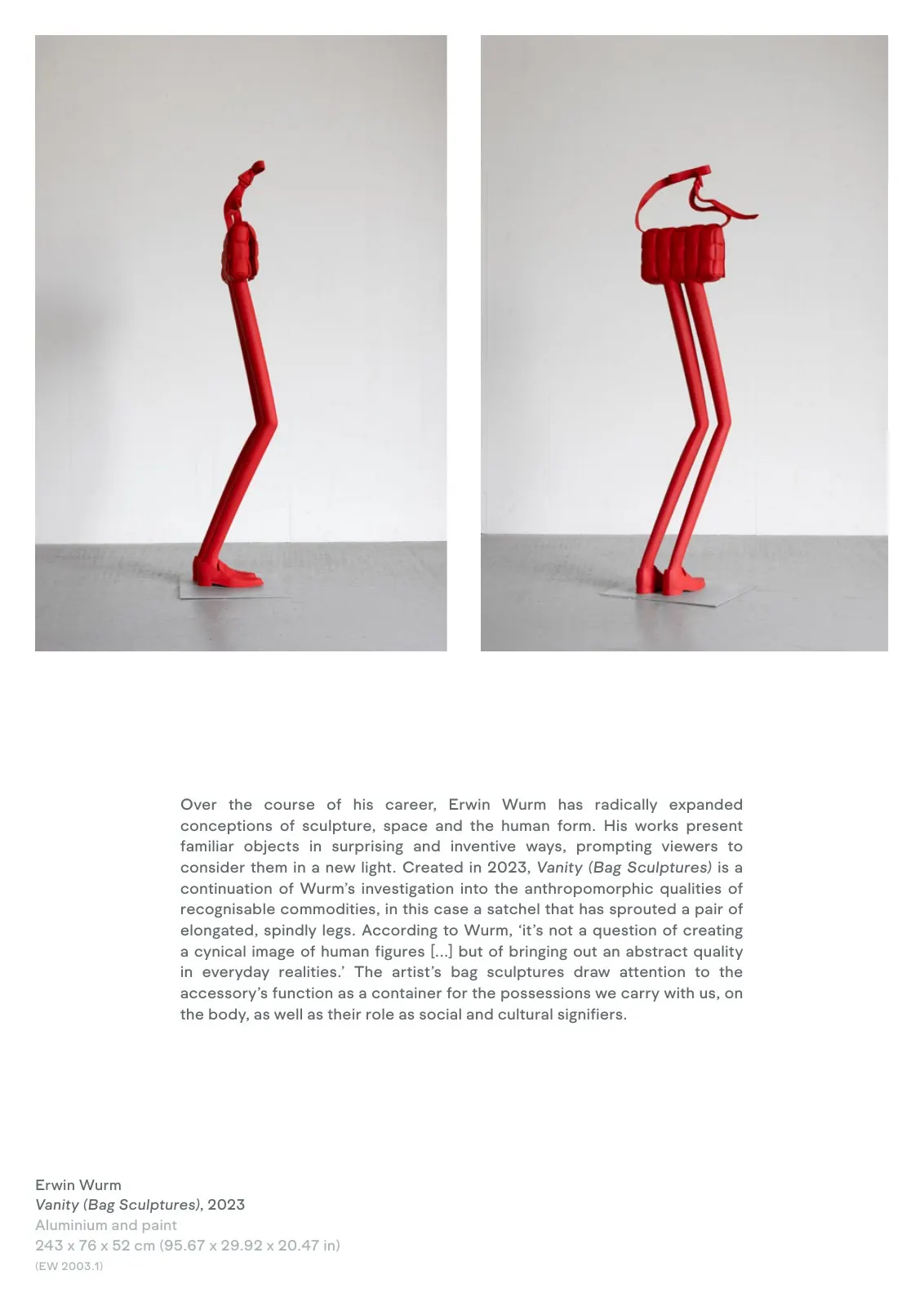
Over the course of his career, Erwin Wurm has radically expanded conceptions of sculpture, space and the human form. His works present familiar objects in surprising and inventive ways, prompting viewers to consider them in a new light. Created in 2023, Vanity (Bag Sculptures) is a continuation of Wurm’s investigation into the anthropomorphic qualities of recognisable commodities, in this case a satchel that has sprouted a pair of elongated, spindly legs. According to Wurm, ‘it’s not a question of creating a cynical image of human figures [...] but of bringing out an abstract quality in everyday realities.’ The artist’s bag sculptures draw attention to the accessory’s function as a container for the possessions we carry with us, on the body, as well as their role as social and cultural signifiers. Erwin Wurm Vanity (Bag Sculptures), 2023 Aluminium and paint 243 x 76 x 52 cm (95.67 x 29.92 x 20.47 in) (EW 2003.1) Erwin Wurm Vanity (Bag Sculptures), 2023 Aluminium, paint 243 x 76 x 52 cm (95.67 x 29.92 x 20.47 in) (EW 2003.1) [金额已省略] (plus applicable taxes)
Source text · Page 11
Alex Katz Lilies 8, 2025 Oil on linen 214 x 152.6 cm (84 x 60 in) (AKZ 2535) Alex Katz Lilies 8, 2025 Oil on linen 214 x 152.6 cm (84 x 60 in) (AKZ 2535) [金额已省略] (plus applicable taxes)
Source text · Page 14
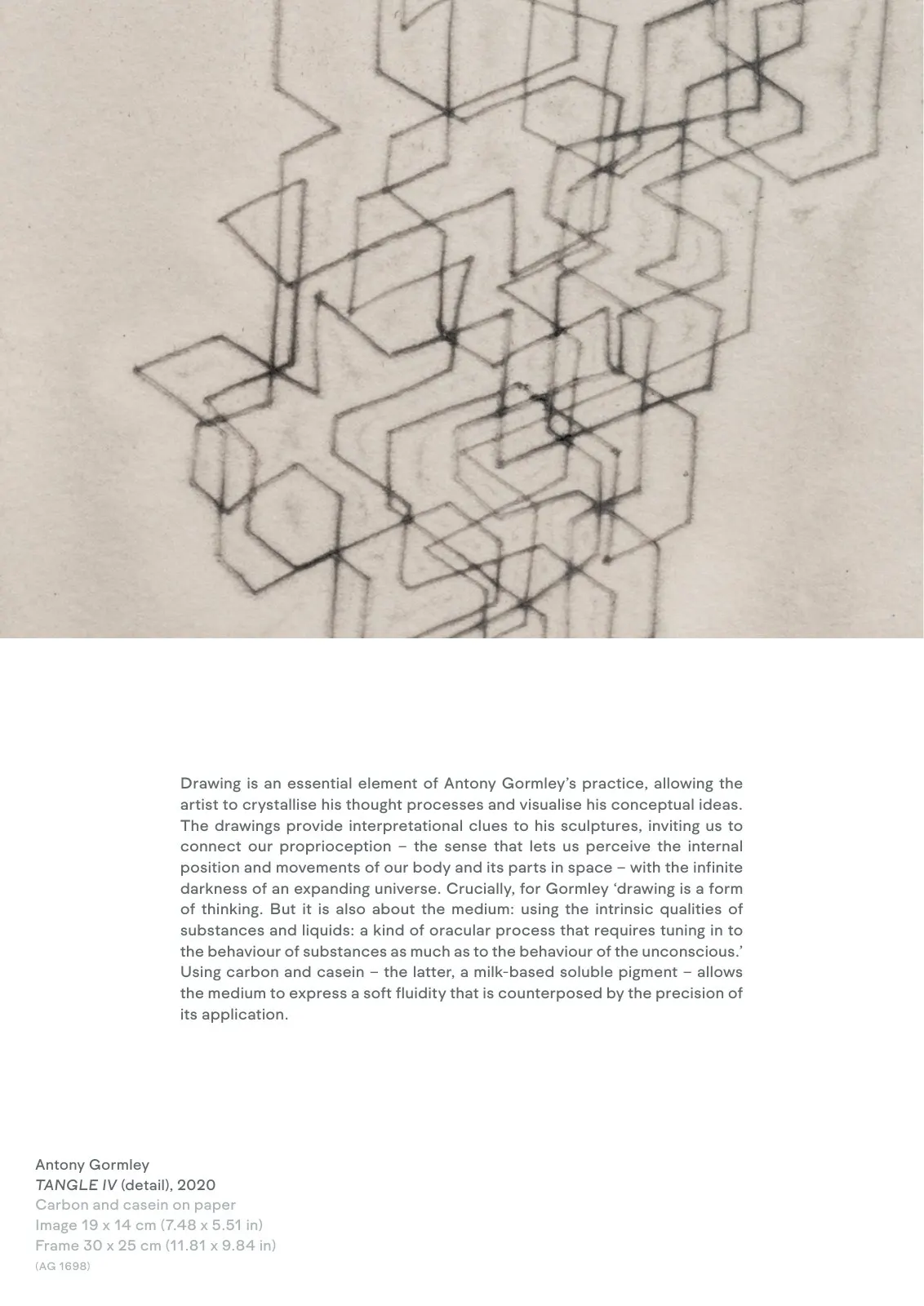
Antony Gormley TANGLE IV (detail), 2020 Carbon and casein on paper Image 19 x 14 cm (7.48 x 5.51 in) Frame 30 x 25 cm (11.81 x 9.84 in) (AG 1698) Antony Gormley TANGLE IV, 2020 Carbon and casein on paper Image 19 x 14 cm (7.48 x 5.51 in) Frame 30 x 25 cm (11.81 x 9.84 in) (AG 1698) [金额已省略] (plus applicable taxes) Drawing is an essential element of Antony Gormley’s practice, allowing the artist to crystallise his thought processes and visualise his conceptual ideas. The drawings provide interpretational clues to his sculptures, inviting us to connect our proprioception – the sense that lets us perceive the internal position and movements of our body and its parts in space – with the infinite darkness of an expanding universe. Crucially, for Gormley ‘drawing is a form of thinking. But it is also about the medium: using the intrinsic qualities of substances and liquids: a kind of oracular process that requires tuning in to the behaviour of substances as much as to the behaviour of the unconscious.’ Using carbon and casein – the latter, a milk-based soluble pigment – allows the medium to express a soft fluidity that is counterposed by the precision of its application.
Source text · Page 18
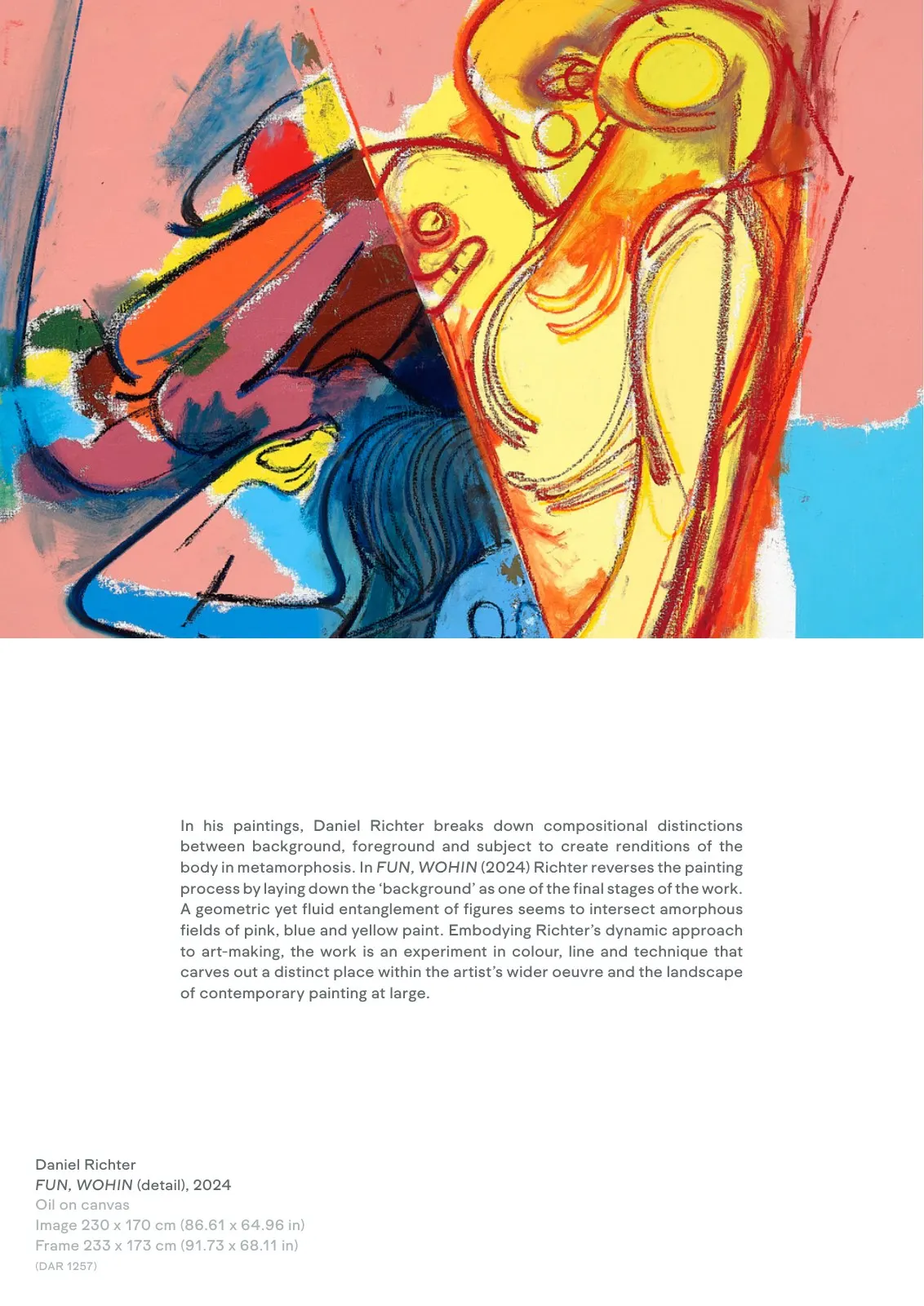
In his paintings, Daniel Richter breaks down compositional distinctions between background, foreground and subject to create renditions of the body in metamorphosis. In FUN, WOHIN (2024) Richter reverses the painting process by laying down the ‘background’ as one of the final stages of the work. A geometric yet fluid entanglement of figures seems to intersect amorphous fields of pink, blue and yellow paint. Embodying Richter’s dynamic approach to art-making, the work is an experiment in colour, line and technique that carves out a distinct place within the artist’s wider oeuvre and the landscape of contemporary painting at large. Daniel Richter FUN, WOHIN (detail), 2024 Oil on canvas Image 230 x 170 cm (86.61 x 64.96 in) Frame 233 x 173 cm (91.73 x 68.11 in) (DAR 1257)
Source text · Page 21
Mandy El-Sayegh Net-Grid Study (In God We Trust, cadmium), 2025 Oil and acrylic on silkscreened linen 138 x 116 cm (54.3 x 45.6 in) (MES 1224) Net-Grid Study (In God We Trust, cadmium) (2025) is part of Mandy El- Sayegh’s ongoing Net-Grid series, begun in 2010. In these works, El-Sayegh overlays silkscreen prints combining personal memorabilia, found objects and linguistic elements with hand-painted grids to consider the proliferation of materials and information, as well as the structures that contain them. Like her large-scale grid works, El-Sayegh’s Net-Grid Study paintings feature layers of material drawn intuitively from the artist’s collection of source materials. In this case, silkscreened banknotes are layered with painted grids, which function to simultaneously contain and obscure information. Selected for their aesthetic qualities, as well as the inherent mechanisms of irreproducibility in authentic notes, the banknotes candidly suggest the connection between art objects and commerce. Her paintings, as the critic Amie Corry writes, ‘present a sort of topography of contemporary visual culture: how it shimmies and darts, takes apart and desensitises.’ Mandy El-Sayegh Net-Grid Study (In God We Trust, cadmium), 2025 Oil and acrylic on silkscreened linen 138 x 116 cm (54.3 x 45.6 in) (MES 1224) [金额已省略] (plus applicable taxes)
Source text · Page 25
Joan Snyder Come to Pearl Pond, 2024 Oil, acrylic, burlap, paper mache, poppy pods, rose buds, dried flowers, straw, paper and ink on canvas in two parts Overall 121.92 x 121.92 cm (48 x 48 in) Each 121 x 61.1 cm (47.63 x 24.05 in) (JSN 1099) Joan Snyder has developed a complex, collaged materiality in her art over the past six decades, building a vocabulary of recurring personal motifs that include roses, breasts, grapes, eyes, totems and cherry trees, as well as the brushstroke itself. Come to Pearl Pond (2024) marks the artist’s renewed interest in the pond, both as a symbol and a formal device. Created by pouring paint directly onto the canvas, here it collects rose buds, dried flowers and poppy pods which seem to float on its pooling, abstract surface. The art historian Susan L. Aberth connects the motif to Snyder’s mystical impulse, describing them as ‘nature’s scrying mirrors’ in which we might find reflected prophecies of selfhood. The work combines autobiographical narrative with abstraction as Snyder arranges rows of gestural strokes along the right side of the composition. With its religious art-historical connotation, this diptych format casts the painting as a kind of personal reliquary. Joan Snyder Come to Pearl Pond, 2024 Oil, acrylic, burlap, paper mache, poppy pods, rose buds, dried flowers, straw, paper, ink on canvas in two parts Overall 121.92 x 121.92 cm (48 x 48 in) Each 121 x 61.1 cm (47.63 x 24.05 in) (JSN 1099) [金额已省略] (plus applicable taxes)
Source text · Page 28
Tom Sachs Woman seated in a Chair, 2025 Synthetic polymer and ink on canvas 148.6 x 109.2 cm (58.5 x 43 in) (TSA 1541) Tom Sachs Woman seated in a Chair, 2025 Synthetic polymer and ink on canvas 148.6 x 109.2 cm (58.5 x 43 in) (TSA 1541) [金额已省略] (plus applicable taxes)
Source text · Page 31
David Salle Bow Ties (detail), 2025 Oil, acrylic, Flashe and charcoal on archival UV print on linen Image 111.76 x 172.72 cm (44 x 68 in) Frame 123.5 x 184.2 cm (48.6 x 72.5 in) (DS 1201) David Salle Bow Ties, 2025 Oil, acrylic, flashe, and charcoal on archival UV print on linen 111.76 x 172.72 cm (44 x 68 in) (DS 1201) [金额已省略] (plus applicable taxes)
Source text · Page 35
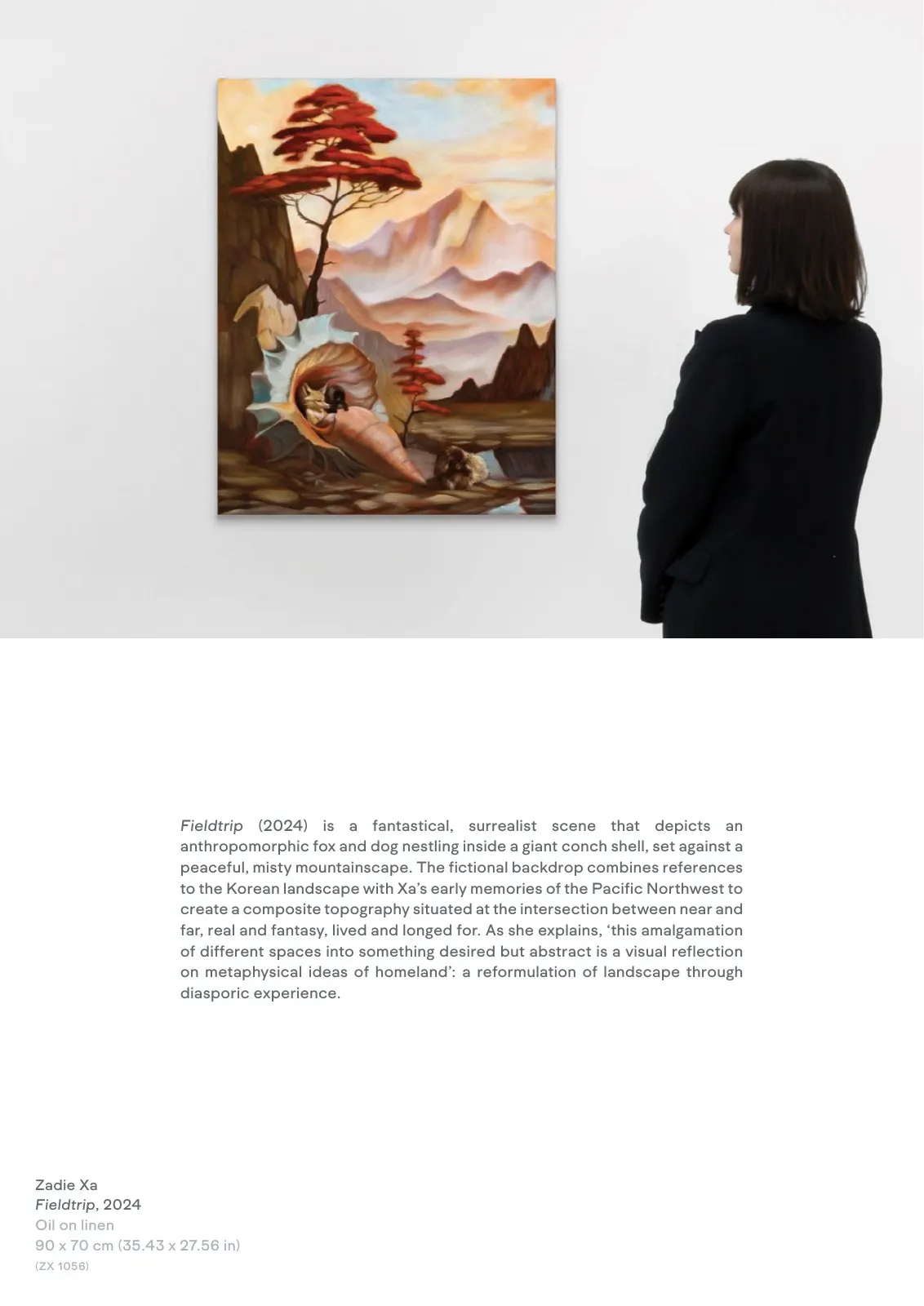
Fieldtrip (2024) is a fantastical, surrealist scene that depicts an anthropomorphic fox and dog nestling inside a giant conch shell, set against a peaceful, misty mountainscape. The fictional backdrop combines references to the Korean landscape with Xa’s early memories of the Pacific Northwest to create a composite topography situated at the intersection between near and far, real and fantasy, lived and longed for. As she explains, ‘this amalgamation of different spaces into something desired but abstract is a visual reflection on metaphysical ideas of homeland’: a reformulation of landscape through diasporic experience. Zadie Xa Fieldtrip, 2024 Oil on linen 90 x 70 cm (35.43 x 27.56 in) (ZX 1056) Zadie Xa Fieldtrip, 2024 Oil on linen 90 x 70 cm (35.43 x 27.56 in) (ZX 1056) [金额已省略] (plus applicable taxes)
Source text · Page 38
Frieze Seoul Booth C5 3—6 September 2025 Opening hours Private view (by invitation only) Wednesday 3 September, 11am—7pm Thursday 4 September, 11am—3pm Public access Thursday 4 September, 3pm—7pm Friday 5 September, 11am—7pm Saturday 6 September, 11am—7pm Address Hall C and D COEX 513 Yeongdong-daero Gangnam-gu Seoul