[Ropac] Art Basel 2026 Preview
![[Ropac] Art Basel 2026 Preview](/art-research/archive/ropac-art-basel-2026-preview-page-0003.webp)
Source text · Page 2
Carl Andre Frank Auerbach Miquel Barceló Georg Baselitz Joseph Beuys Jordan Casteel Tony Cragg Marcel Duchamp VALIE EXPORT Sylvie Fleury Lucio Fontana Adrian Ghenie Antony Gormley Hans Josephsohn Martha Jungwirth Alex Katz Imi Knoebel Leoncillo Roy Lichtenstein Robert Longo Liza Lou Robert Mapplethorpe Joan Miró Sigmar Polke Robert Rauschenberg Daniel Richter James Rosenquist Tom Sachs David Salle Oskar Schlemmer Joan Snyder Pierre Soulages Sturtevant Emilio Vedova Not Vital Andy Warhol Zadie Xa Yan Pei-Ming Featured artists
Source text · Page 11
In his quest against ‘retinal art’, Marcel Duchamp shook the art world with his radical concept of the readymade, ‘an ordinary object elevated to the dignity of a work of art by the mere choice of an artist.’ This is epitomised by Trébuchet (1917/64), a readymade that avowedly ‘imposed itself’ on the artist in 1917 . The present work was executed under Duchamp’s direction at Galerie Schwarz in Milan in 1964: an important collaboration that notably also produced the edition of Trébuchet in the collection of the Centre Pompidou, Paris. The original work, which has since been lost, was a humble coat hanger found in his apartment- studio in New York. As Duchamp stated, ‘lt stayed there on the floor and I would always knock against it at every moment. lt drove me mad and I said to myself: l’ve had enough of this; if it wants to stay on the floor, all right, l’m going to nail it.’ Duchamp thus transformed the utilitarian, commercially available object into a momentous artwork, subverting the very notions of art, its display and authorship itself. The playfully irreverent sculpture functions as a potent visual pun. Its title, Trébuchet , refers to a type of zugzwang, shedding light on the fundamental role of chess in Duchamp’s practice, while simultaneously alluding to the French word ‘trébucher’, which means ‘trip’. Original studio photograph showing the Trébuchet on the floor, 1916-17
Source text · Page 21
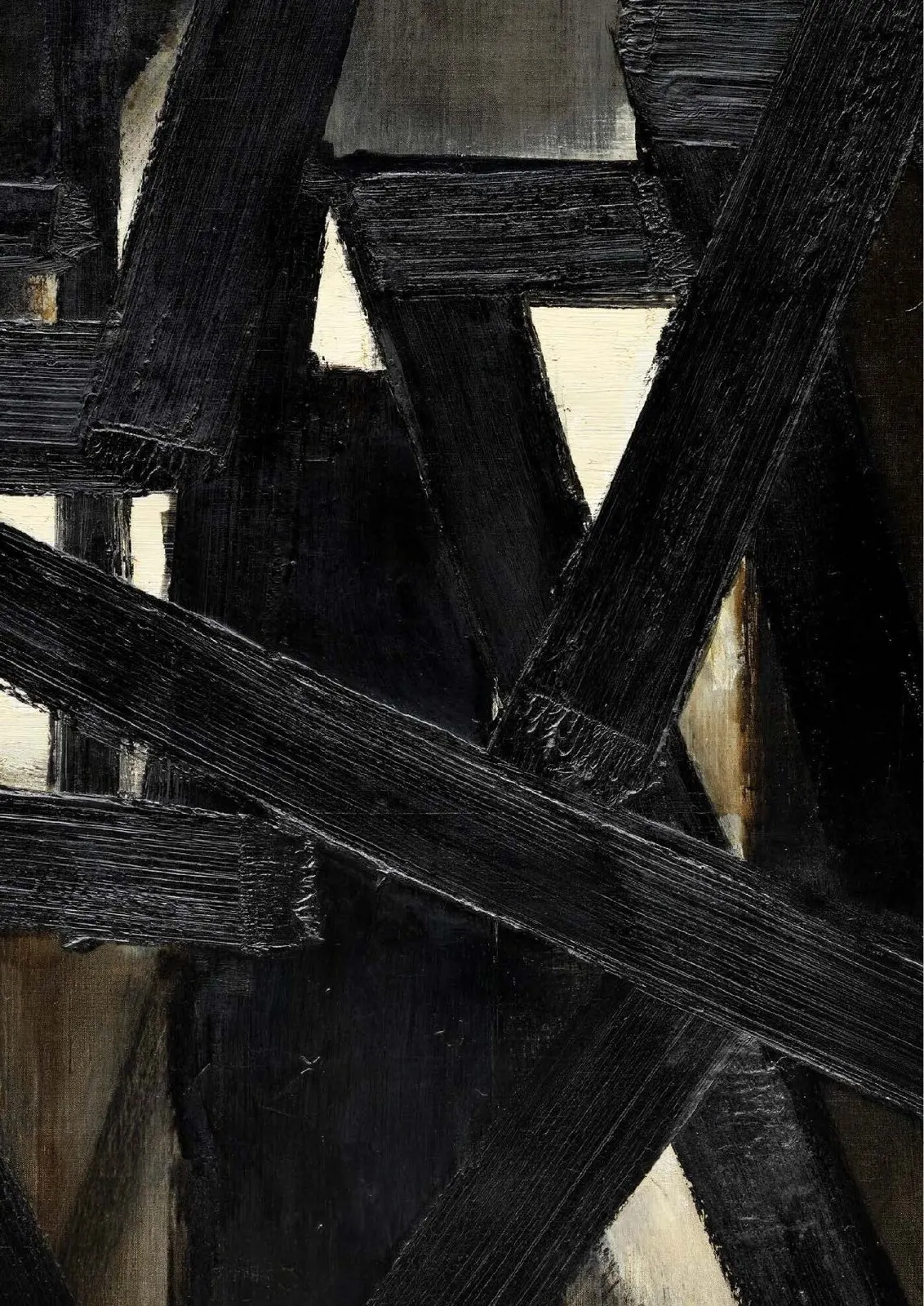
Georg Baselitz Ohne Titel , 2025 Red ink pen on paper 79.7 × 59.2 cm (31.38 × 23.31 in) GB 3057 [金额已省略] (plus applicable taxes)
Source text · Page 30
The show was a resounding success among both critics and American collectors, igniting the French artist’s epoch-defining ascent on the other side of the Atlantic. From Kootz, this work was acquired by John D. Rockefeller III and Blanchette H. Rockefeller, American philanthropists and renowned patrons of the arts, and key early supporters of Soulages. Following Blanchette Rockefeller’s passing in 1992, the work was auctioned, and has since remained in a private collection for over three decades. Peinture 146 × 97 cm, 31 janvier 1954 exhibits an architectural organ- isation of black vertical, horizontal and diagonal beams, underpinned by a largely umber ground, which together structure an investigation of light, which emerges as gleaming fragments nestled within the dark framework. As such, this work represents the culmination of an early period of exploration that Pierre Encrevé, the preeminent art histo - rian and Soulages specialist, designated clair-obscur (‘chiaroscuro’). Encrevé identifies Peinture 146 × 97 cm, 31 janvier 1954 as one of the final three key examples of this stylistic phase – a central thread in the artist’s late 1940s and early 1950s practice that would largely disappear in the important period between 1954 and 1959. Other mas - terpieces from this succinct historic lineage are in the collections of Solomon R. Guggenheim Museum, New York; Centre Pompidou, Paris; Fundação Calouste Gulbenkian, Lisbon; and Tate Modern, London. As Encrevé describes, these works employ ‘one of the great expressive techniques of classical painting, which had never before appeared in abstract art: chiaroscuro’. Indeed, Soulages’s formal approach to light and dark in Peinture 146 × 97 cm, 31 janvier 1954 is evocative of those of Rembrandt, Caravaggio, Diego Velázquez, or indeed Francisco de Goya. His use of obliques creates a compositional tension that recalls the directional light and deep shadows of tenebrism – akin to the in - clined light of Caravaggio’s The Calling of Saint Matthew (1599–1600) – and, Encrevé writes, ‘leave[s] open the possibility of a setting in motion’ or perhaps ‘an interrogation’. The significant utilisation of the diagonal axis provides this work with a remarkable sense of dynamism, while the intersecting angular brushstrokes in thick, haptic impasto assert the physicality of the act of painting and the immense breadth and potency of Soulages’s gesture. Caravaggio, The Calling of Saint Ma/t_thew , 1599–1600 San Luigi dei Francesi, Rome
Source text · Page 40
Alex Katz Black Roses 17 , 2025 Oil on linen 183.5 × 122.6 cm (72.24 × 48.27 in) AKZ 2558 [金额已省略] (plus applicable taxes)
Source text · Page 49
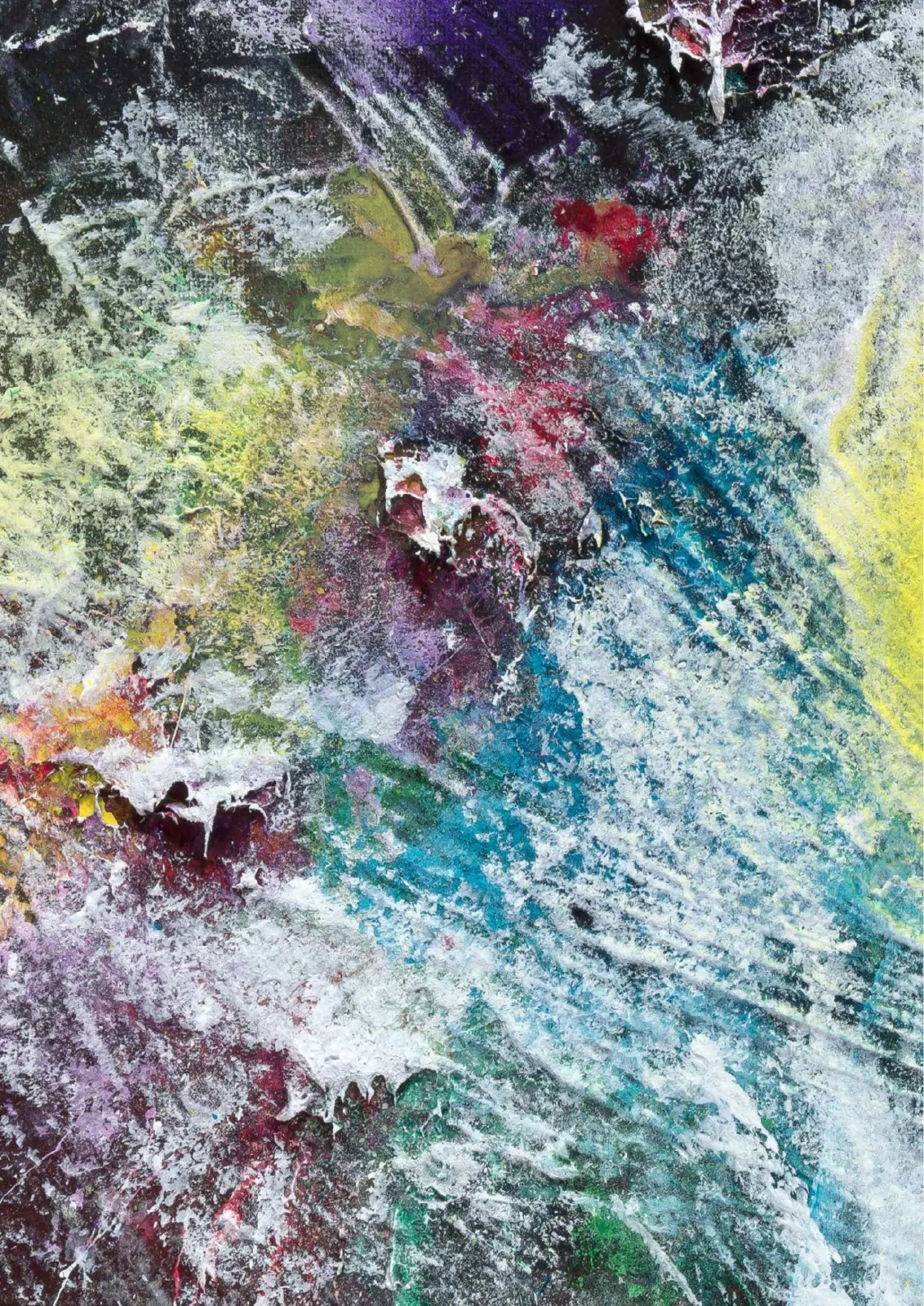
[W]hen I did paintings based on Monet’s I realized everyone would think that Monet was someone I could never do because his work has no outlines and it’s so Impressionistic. It’s laden with incredible nuance and a sense of the different times of day and it’s just completely different from my art. So, I don’t know, I smiled at the idea of making a mechanical Monet. — Roy Lichtenstein Printmaking formed a significant part of Roy Lichtenstein’s practice from the late 1950s to the 1990s. Water Lilies with Cloud , from Water Lilies Series (C. [电话已省略]) is a screenprint on stainless steel made in collabora - tion with Donald Saff at Saff Tech Arts in Maryland. The work responds to Claude Monet’s Water Lilies paintings (1897–1926), which capture the eva- anescent effects of sunlight upon a pond’s surface, scattered with flowers. Roy Lichtenstein Water Lilies with Cloud, from Water Lilies Series (C. 263) (detail), 1992 Screenprinted enamel on processed and swirled stainless steel, with painted aluminium frame 166.4 × 113.7 cm (65.5 × 44.25 in) Ed. PP 1 of 23 + 6 AP , 3 PP , 2 presentation proofs, 1 BAT, 1 National Gallery of Art archive proof, 2 Saff Tech Arts archive proofs RL 1067 [金额已省略] (plus applicable taxes)
Source text · Page 58
This is art that will endure, for it recapitulates sculpture’s ancient function to memorialise, to console, and to celebrate human resilience. — Jackie Wullschläger, art critic Hans Josephsohn’s sculptural practice is characterised by his lifelong preoccupation with the human form. Over the course of six decades, the Swiss artist developed a wholly unique visual language, pushing the boundaries of figurative representation and placing emphasis on the very substance of the human form. In his early works, Josephsohn’s depictions of the human body were still firmly rooted in figuration, bearing distinguishable facial features and body shapes. Untitled (Ruth) (1965) depicts a seated female figure, her arms expressively crossed across her chest. Josephsohn represents Ruth Jacob, his most important model for the twenty years following their first encounter in 1956. Despite the figure’s striking sensuousness, Josephsohn’s tactile treatment of the surface disrupts the work’s representational quality, imbuing the sculpture with a sense of universal humanity. Although cast in brass, the textured surface of the sculpture, with its subtle, variegated colouring, evokes ideas of the topographical, while residing firmly in the realm of the bodily. Hans Josephsohn Untitled (Ruth), 1965 Brass 71 × 30 × 29 cm (27.95 × 11.81 × 11.42 in) Ed. 1 of 6 + 2 AP HJ 1133.1 [金额已省略] (plus applicable taxes) £
Source text · Page 66
I work the clay as if it were time: I shatter it, I reassemble it, I imbue it with the colour of wounded earth. Thus the sculpture becomes both memory and gesture. — Leoncillo One of the greatest Italian sculptors of the postwar period, Leoncillo (1915–1968) propelled the ancient art of ceramics into modernity. He elevated the medium from the perceived realm of decorative arts to ‘an entirely new type of sculpture […] with a poetic authority that had no precedents outside of the Renaissance and the works of Luca della Robbia,’ argues art historian Andrea Bacchi. While Leoncillo’s early work was predominantly figurative, sharing affinities with the expressionist Scuola Romana, the Second World War initiated a profound shift in his practice towards an avant-garde mode of abstraction, which aligned with Arte Informale in its union of gesture, texture and spontaneity. Deeply engaged with matter, the artist conceived clay not merely as a docile material but as a living substance that bore the potential of both destruction and renewal, discerning an existential transformative power in its firing process. His uniquely expressive oeuvre garnered critical acclaim, notably earning him the sculpture prize at the Venice Biennale of 1968. Leoncillo Tre Tagli (A, B, C), 1967 Terracotta A: 46 cm (18.1 in) B: 45.6 cm (17.9 in) C: 44.5 cm (17.5 in) LEO 1001 [金额已省略] (plus applicable taxes)
Source text · Page 77
Georg Baselitz Ohne Titel , 2025 Ink pen on paper 58.7 × 79.7 cm (23.11 × 31.38 in) GB 2909 [金额已省略] (plus applicable taxes) In this work on paper from 2025, Baselitz depicts two figures floating horizontally amid the pictorial plane. The figures both represent the artist’s wife, Elke, a constant presence in his imagery since the first upside-down portrait he painted of her in 1969. The work is a continuation of Baselitz’s experimentation with double portraits which he commenced in the 1970s with Bedroom , in which he represented himself and Elke nude. Here, Baselitz diverges from the original double portrait by depicting his muse twice. Rendered in spindly strokes and blotches of black ink, both figures exude corporeal frailty, forming a meditation on the ageing body. Baselitz was remarkable for his ability to convey the poignant and sincere through a medium that is gossamer and exquisitely light, in a way that, as Blistène once put it, ‘exhales the pleasure of painting.’ His drawings present a vision that is – as Andreas Zimmermann has commented about Baselitz’s late work – ‘filigree and powerful at once: a typical Baselitz paradox.’
Source text · Page 85
Flowers are actually some of the most difficult forms to paint, because you have to capture their spatial aspect, their physicality, the surface of the flowers and the colours. You hope the whole painting will give the sensation of seeing a flower – the brilliance of that experience. —Alex Katz A testament to Alex Katz’s striking mastery of colour, in Red Flowers 2 (2025), twelve soft vermillion flowers are scattered atop a golden yellow ground, emerging in full bloom from all corners of the painting. Viewed from above, the pointed curves of their supple petals unfold like wind - mills, imbuing the work with a dynamic energy as the diagonal lines of their stalks direct the viewer’s eye across the canvas. Recognising that his recent flower paintings differ from his earlier representations of the subject, Katz says, ‘they’re more descriptive of volumes. They’re more sculptural. In the end, they look like they’re in the wind.’ Decontextualised from any environment, the composition of Red Flowers 2 could theo - retically be continued indefinitely, transposing the ‘all-over’ treatment of the canvas found among Abstract Expressionists to create a painting that gives a sense of a boundless, immeasurable reality. As Prudence Peiffer observes, ‘All of the features central to Katz’s signature art are worked out to their most unexpected degree in his flowers.’ Alex Katz Red Flowers 2, 2025 Oil on linen 152.4 × 121.9 cm (60 × 48 in) AKZ 2564 [金额已省略] (plus applicable taxes)
Source text · Page 94
Andy Warhol Guns, 1981-82 Acrylic and silkscreen ink on canvas 40.5 × 50.7 cm (15.94 × 19.96 in) AW 1331 [金额已省略] (plus applicable taxes) This work is part of Andy Warhol’s portentous Gun paintings (1981–82), which provide an unparalleled insight into the elusive artist’s psyche. In 1968, Valerie Solanas shot Warhol in the torso – a traumatic experience that irrigated the resuscitated artist’s life and work from then on. As Factory member Vincent Fremont recalls, ‘Having nearly been killed by a handgun Andy was able to make paintings of guns as iconic objects. In order to choose which guns he would use we made calls to friends who might know someone with a gun. A few scary people, with first names only, came by and let Andy take Polaroids of their weapons. I remember him photographing a saw-off shotgun.’ Here, Warhol depicts a snub-nosed .32 calibre handgun: the same model Solanas attempted to assassinate him with. In this striking portrait of the gun, the artist superimposes two silkscreened pistols, in a manner reminiscent of chronophotography, one of which tilts menacingly upwards. The backdrop of the work, meanwhile, is coated in abstract brushwork in pastel tones – making it one of his final paintings with conspicuous strokes –, which lends the work a lyrical expressivity that clashes with the chillingly mechanical nature of the firearm. As such, Guns grapples with both Warhol’s own fraught relationship with mortality and ‘the thanatological flip side of American culture’, as curator Douglas Fogle has written.
Source text · Page 102
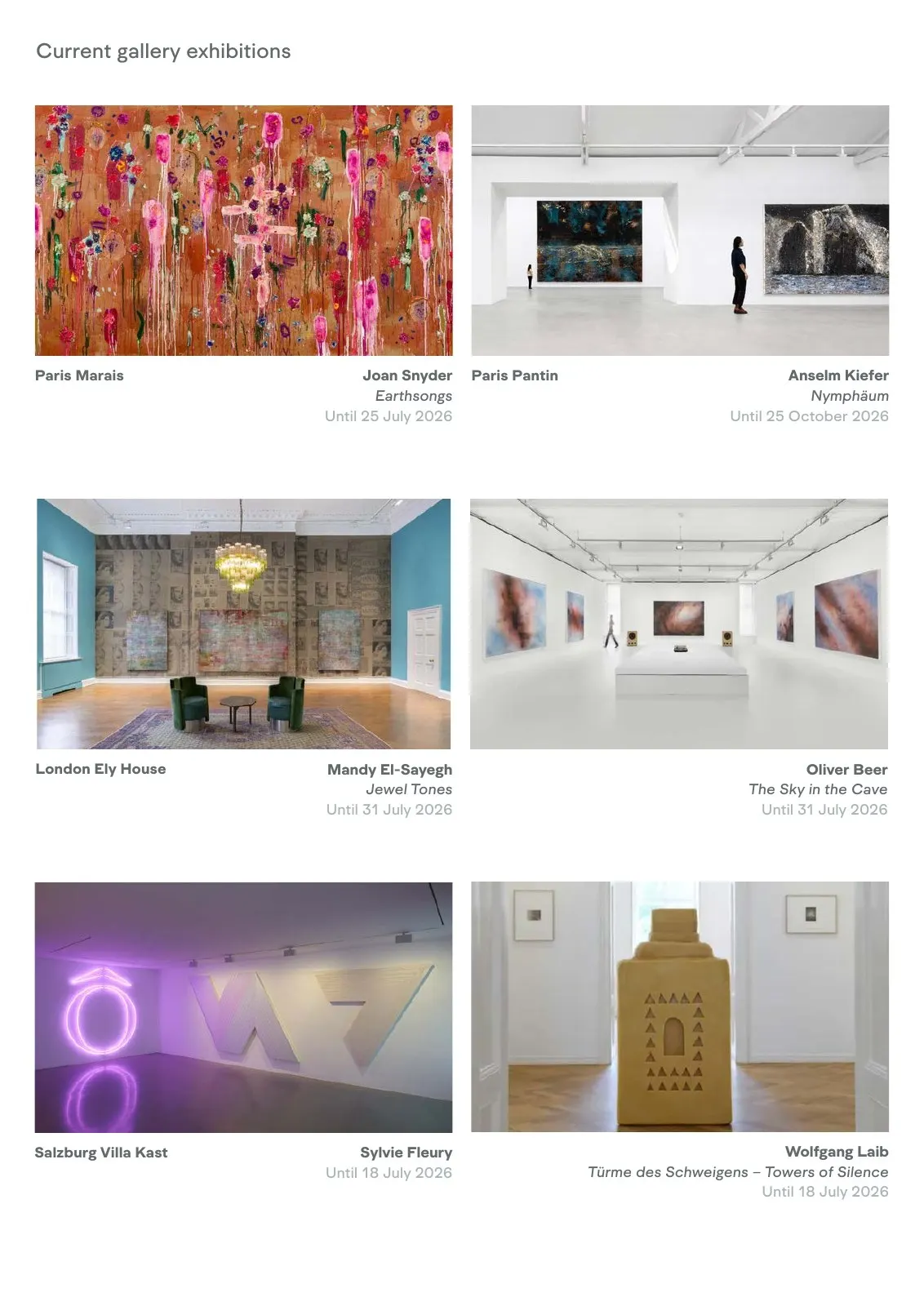
Current gallery exhibitions Seoul Fort Hill Alex Katz Studies Until 1 August 2026 Han Bing, Megan Rooney, Joan Snyder That Inward Eye Until 1 August 2026 Milan Marcel Duchamp /ampersand.ss05 Sturtevant Dialogues are mostly fried snowballs Until 23 July 2026 Joan Miró Sculptures Until 4 July 2026 Salzburg Villa Kast