Guan Xiao | Info PDF | David Kordansky Gallery
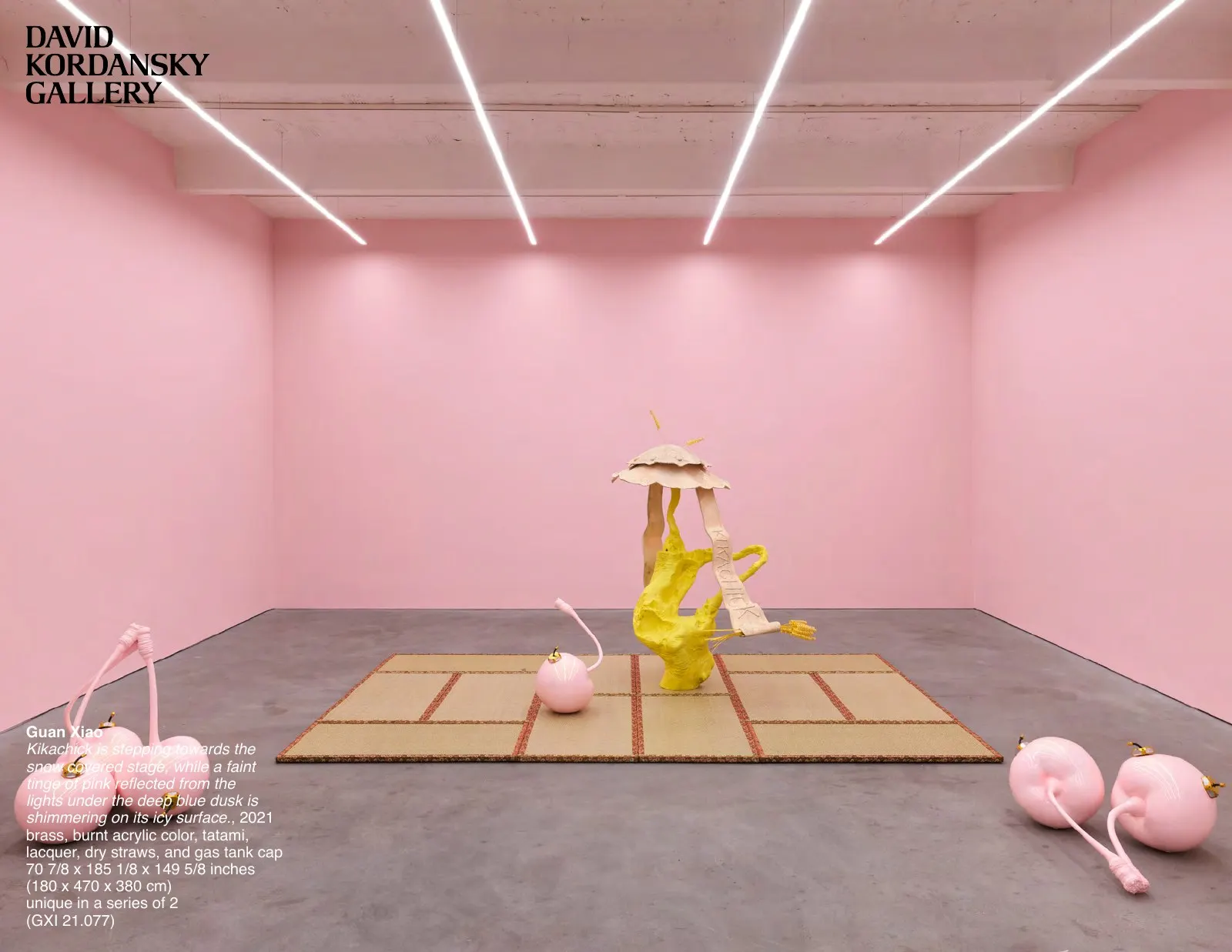
Source text · Page 1
[邮箱已省略] [网址已省略] T: 323.935.3030 GUAN XIAO
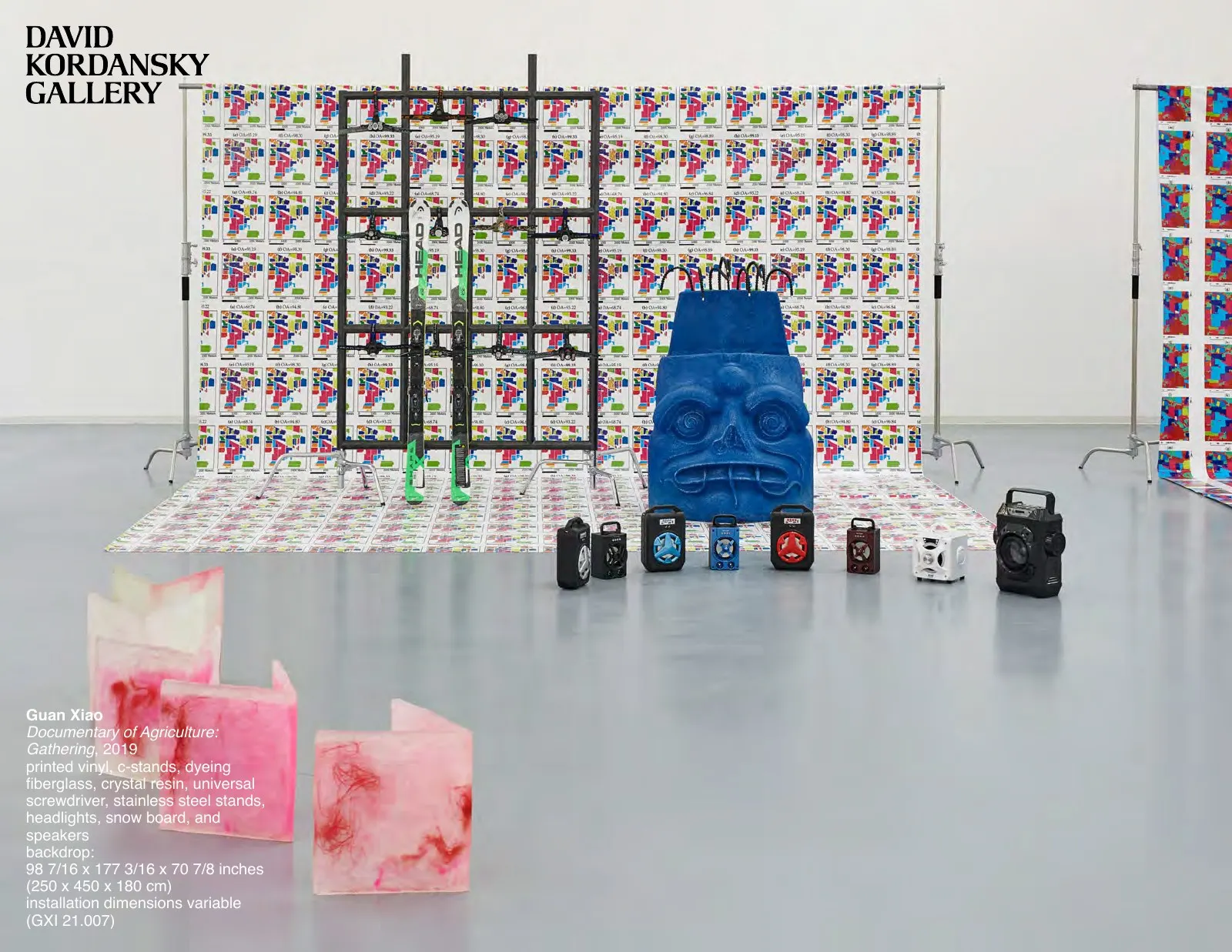
Source text · Page 9
Guan Xiao Messenger, 2020 pigmented bronze, lacquer, porcelain, motorcycle parts, and dried flowers 72 7/8 x 43 1/3 x 16 1/8 inches (185 x 110 x 41 cm) (GXI 21.066)
Source text · Page 17
Guan Xiao USAUSB, 2011 resin, metal, and spray paint 67 x 47 1/4 x 47 1/4 inches (170 x 120 x 120 cm) (GXI 21.097)
Source text · Page 24
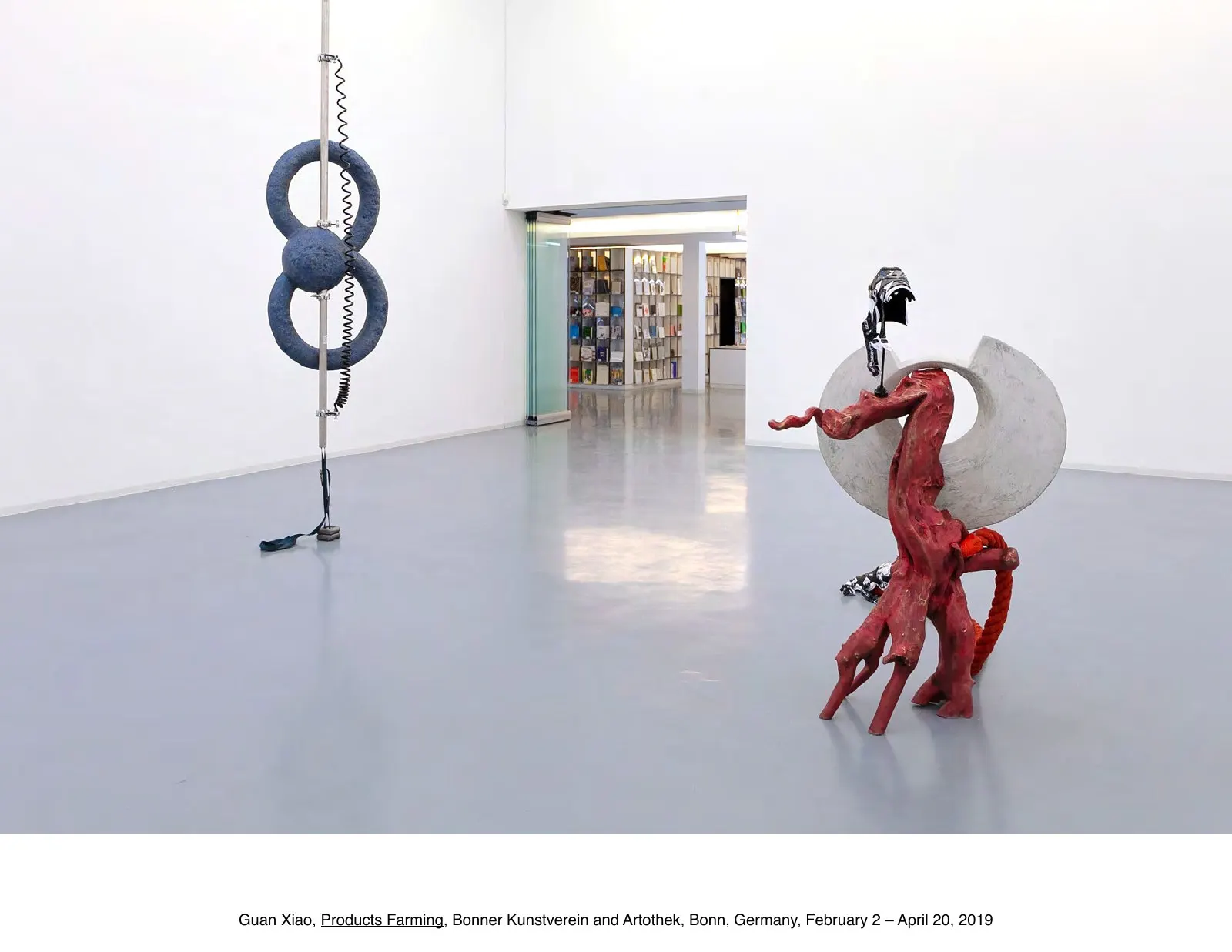
Guan Xiao, Products Farming, Bonner Kunstverein and Artothek, Bonn, Germany, February 2 – April 20, 2019
Source text · Page 32
Guan Xiao, Weather Forecast, Jeu de Paume, Bordeaux, France, June 7 – September 25, 2016
Source text · Page 40
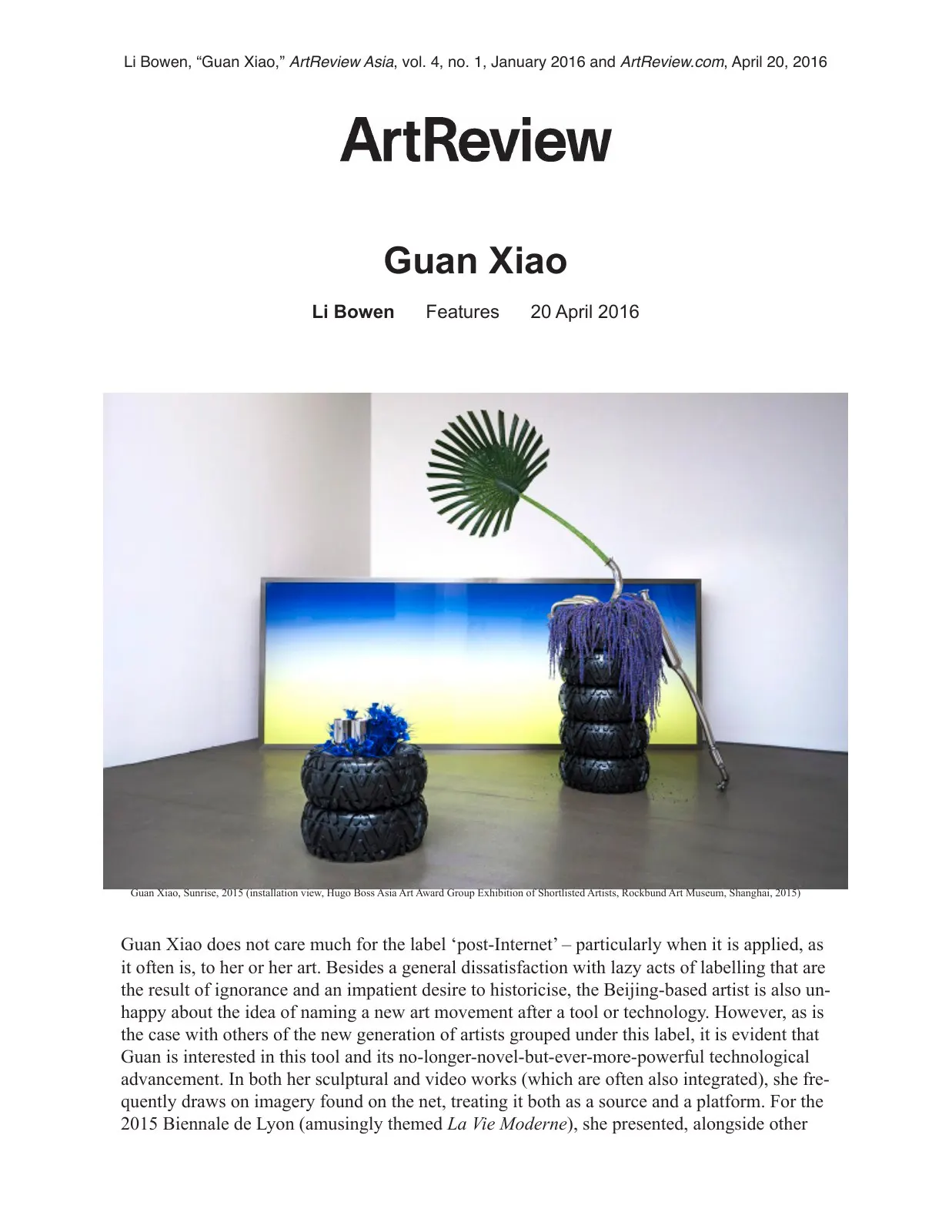
Guan Xiao, Elastic Sleep, chi K11 art museum, Shanghai, China, October 25, 2015 – November 30, 2016
Source text · Page 48
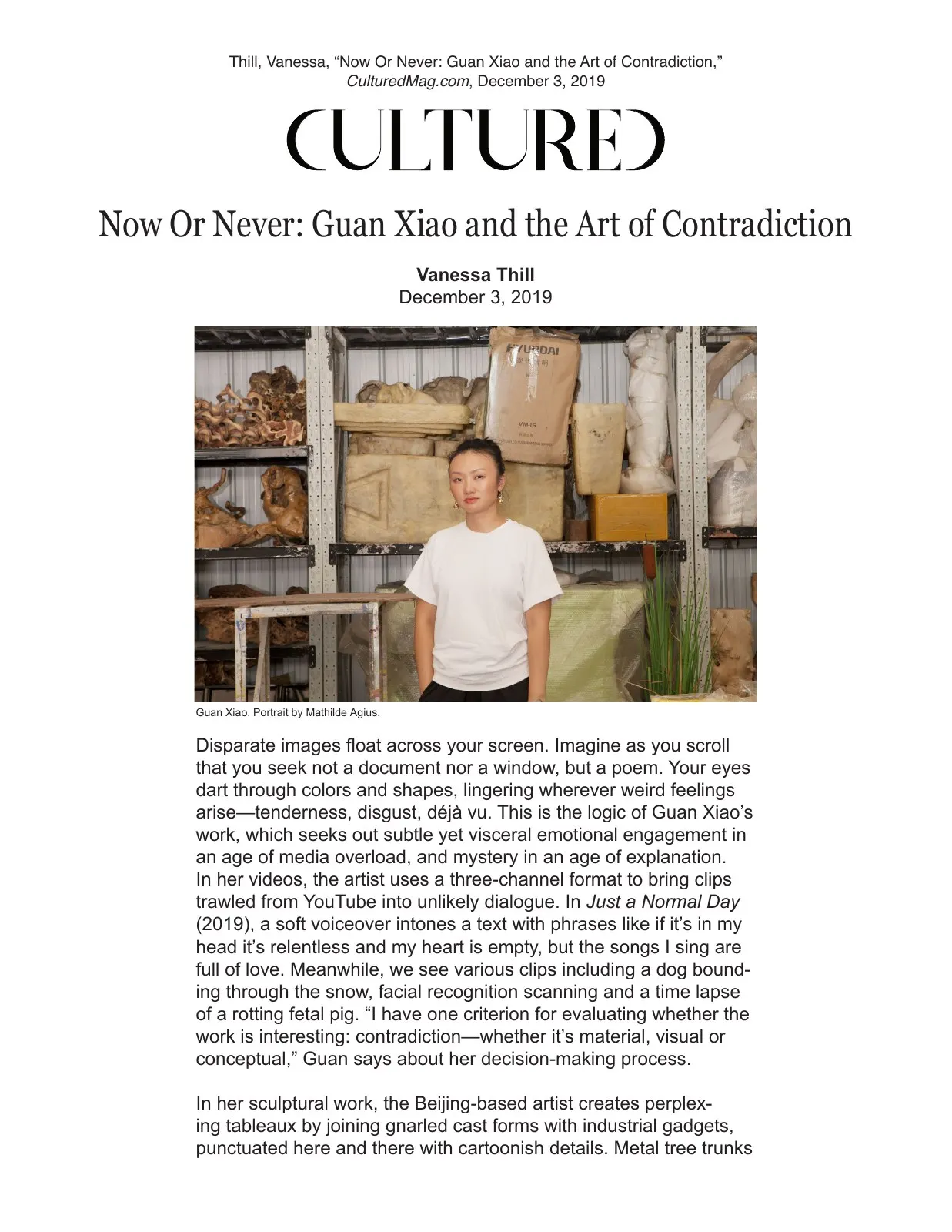
Solomon, Tessa, “Guan Xiao, Artist With an Eye on Our Hyper-Online Lives, Joins David Kordansky Gallery,” ArtNews. com, April 12, 2022 ask, What modern notions are really bygone traditions under a fresh coat of paint? Do objects change when seen or touched? Do we? Guan Xiao, ‘Dengue, Dengue, Dengue’, 2017, three-channel video, color, sound. COURTESY THE ARTIST, DAVID KORDANSKY GALLERY, ANTENNA SPACE, AND KRAUPA- TUSKANY ZEIDLER Her work is narrative-heavy, and the videos she makes, in particular, mirror a hyper-online, hy- per-global life as a ceaseless onslaught of information. Guan sometimes asks a lot of the viewer, but only because she dedicates herself entirely to the act of looking. She is a relentless observer, chewing over the implications of massive amounts of data: she teases convincing links between an incredible array of material, like Western art history, capitalism, ancient Chinese sculpture, jazz, and surveillance technology. She also leaves room for the viewer to project their own stories onto her art. A 2020 solo exhi- bition at Antenna Space featured some 15 sculptures of fantastical beings who were assigned biographies of varying opacity, freeing them to become monuments to no fixed history. To learn more about her practice, ARTnews spoke with Guan over email. The artist’s responses were translated from Chinese. Can you walk me through the creation of one of your artworks? How do you decide a work is interesting? Every piece of my work leaves me with deep impressions. Because they are all different in struc- ture, ways of association, and material. Art practice is unlike courtship, where one hopes to find the most suitable one, or thinking that your current partner knows you better than your ex, or even, the butterfly you had for your first love was the apex. Art practice is not a kind of life ex- perience but something rigorous and inspiring. Each piece exists for a unique reason and some- thing to communicate with others, and its making is always an unknown challenge.
Source text · Page 56
Theurer, Sarah Johanna, “Guan Xiao in Conversation with Sarah Johanna Theurer,” CURA Magazine #36, April 16, 2021, pp. 113-130
Source text · Page 64
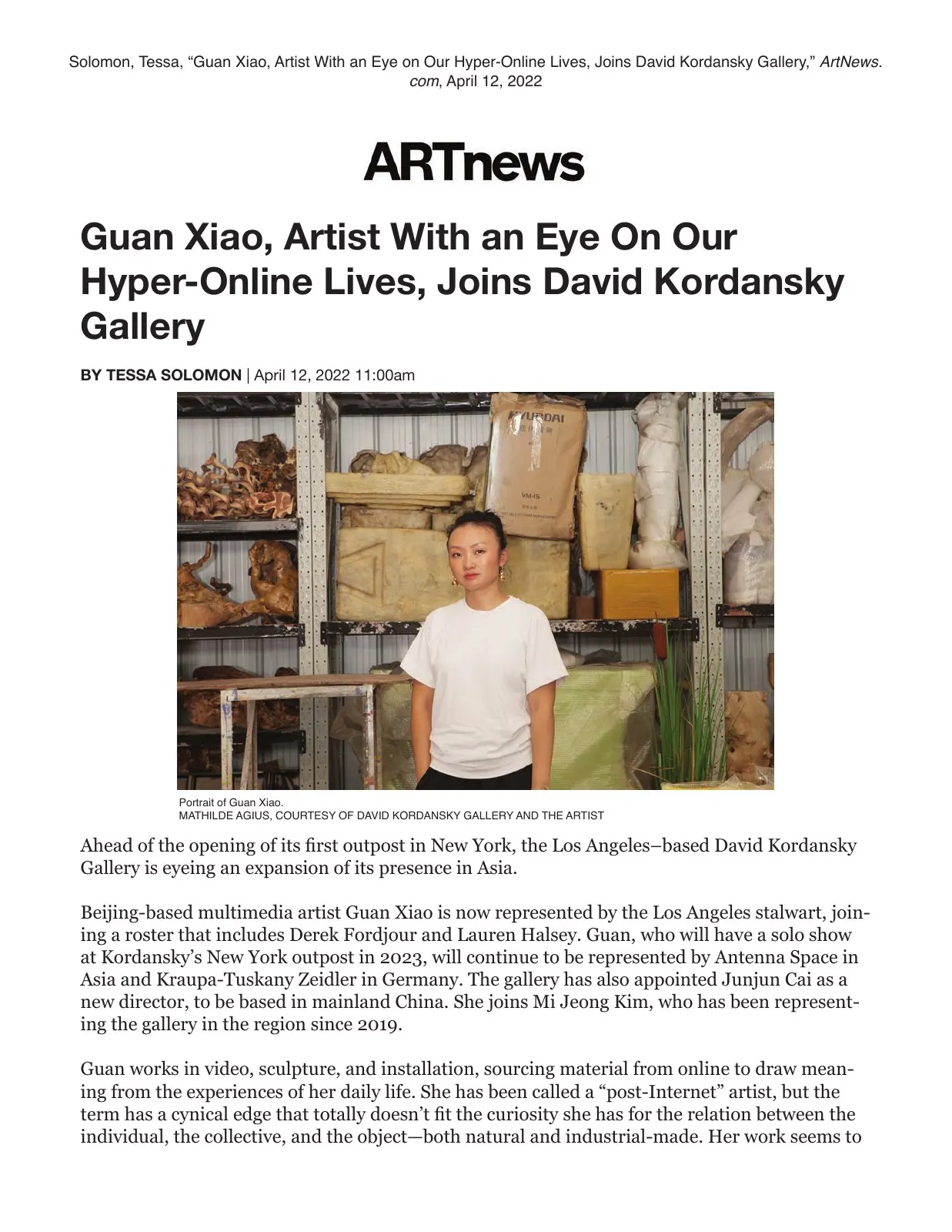
Thill, Vanessa, “Now Or Never: Guan Xiao and the Art of Contradiction,” CulturedMag.com, December 3, 2019 Now Or Never: Guan Xiao and the Art of Contradiction Vanessa Thill December 3, 2019 Disparate images float across your screen. Imagine as you scroll that you seek not a document nor a window, but a poem. Your eyes dart through colors and shapes, lingering wherever weird feelings arise—tenderness, disgust, déjà vu. This is the logic of Guan Xiao’s work, which seeks out subtle yet visceral emotional engagement in an age of media overload, and mystery in an age of explanation. In her videos, the artist uses a three-channel format to bring clips trawled from YouTube into unlikely dialogue. In Just a Normal Day (2019), a soft voiceover intones a text with phrases like if it’s in my head it’s relentless and my heart is empty, but the songs I sing are full of love. Meanwhile, we see various clips including a dog bound- ing through the snow, facial recognition scanning and a time lapse of a rotting fetal pig. “I have one criterion for evaluating whether the work is interesting: contradiction—whether it’s material, visual or conceptual,” Guan says about her decision-making process. In her sculptural work, the Beijing-based artist creates perplex- ing tableaux by joining gnarled cast forms with industrial gadgets, punctuated here and there with cartoonish details. Metal tree trunks Guan Xiao. Portrait by Mathilde Agius.
Source text · Page 71
“Berlin Gallery Weekend 5/6: Guan Xiao,” interview by Franklin Melendez, Kaleidoscope, April 28, 2017
Source text · Page 79
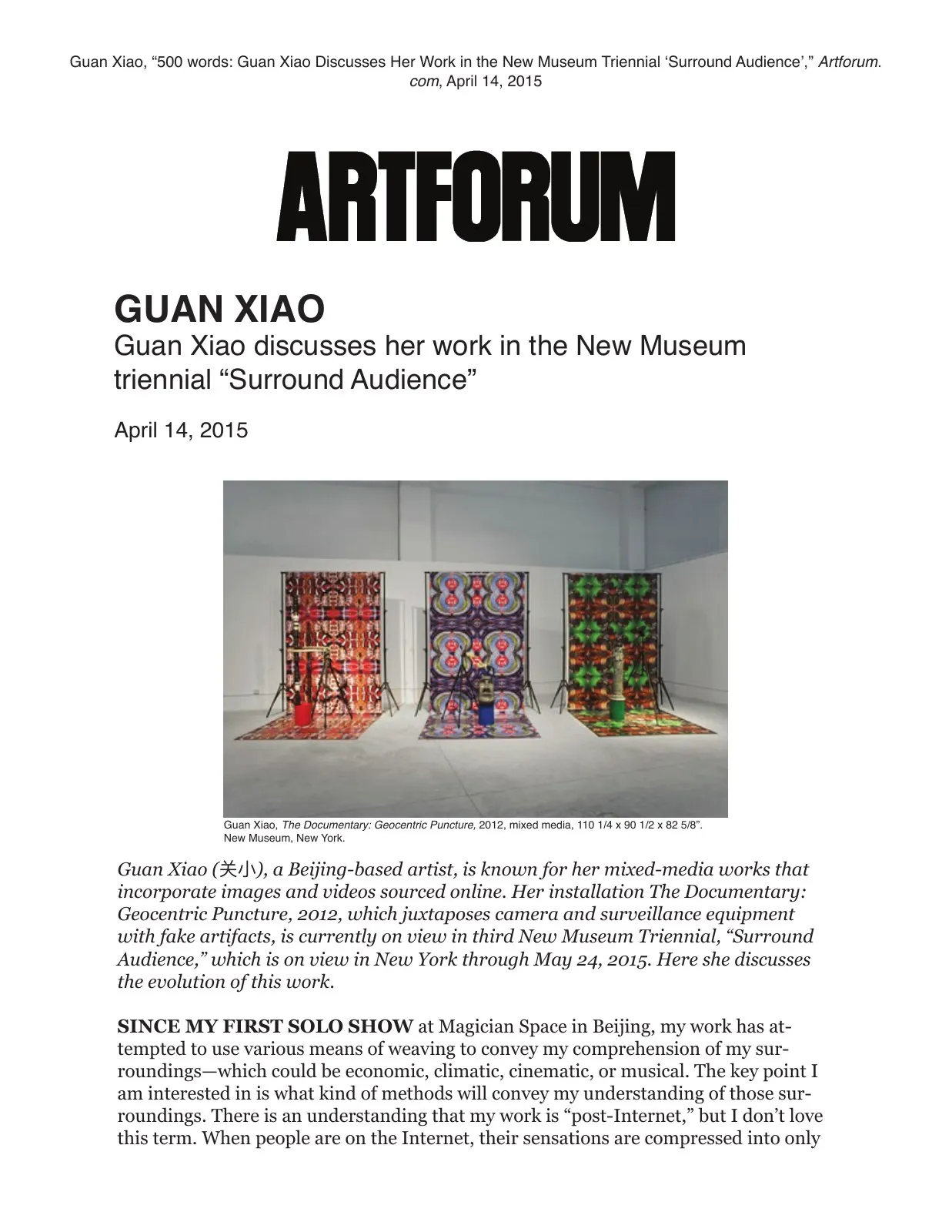
Guan Xiao, “500 words: Guan Xiao Discusses Her Work in the New Museum Triennial ‘Surround Audience’,” Artforum. com, April 14, 2015 two dimensions: sight and hearing, that is, picture and voice. Many of my video works make use of the relation and combination of these two dimensions and pass along rich- er meaning. In addition, I have developed a stubborn perspective on the “new” and the “old”: What we consider today as new or advanced things are actually things that are ancient or unknown. The incomprehension of the past and unknowns gives rise to intriguing discussion in the present. That’s why I have been prone to putting these extreme things together—the old and new—and making them work together. I admit that my approach for making videos is quite different from how I make sculp- ture. For my videos, I have to have a clear idea before I start working; when I work on my sculptures, however, a random feeling always comes prior to the plan—a starting point could just be a subtle sense from an object. My working processes for these two media stride from two ends toward a balanced state in the middle. The Documentary: Geocentric Puncture was a remarkable turning point for me. I realized that, for ex- ample, I’d like to place something very new and something very old together. I chose to work with camera tripods. In the beginning I didn’t think about their meaning as objects. I began to think about their physical structures—apparently they are function - al, industrial-designed structures, but for me they are a more traditional, classic form. Then I attempted to deal with these objects as if people touched them. This approach imbues the objects with a strong sense of individual existence. Finally, I placed a back- drop behind all these objects, which offers a correlation of seeing and being seen, like in a photo studio. This is also an important element of my sculptural practice: It should always have multiple layers. I think I belong to the old school, even though I can easily take interest in new things. But only if these things offer me something “constant” that can stir up a kind of true feeling for me. I could not gain any understanding from new things if they lacked this constancy. From this point of view, I guess I am more like an observer: ready to betray this world, while always being loyal to it in my own way. Translated from Chinese by Qianxi Liu (刘倩兮). — As told to Yang Beichen ( 杨北辰)
Source text · Page 87
[邮箱已省略] [网址已省略] T: 323.935.3030 F: 323.935.[电话已省略] Wee, Daryl, “Hugo Bossa Asia Art 2015 Shortlist Announced,” BlouinArtinfo.com, June 26, 2015 Whittaker, Iona, “Artist Profile: Guan Xiao,” Rhizome.org, April 22, 2015 Guan Xiao, “500 words,” Artforum.com, April 14, 2015 Moore, Christopher, “Best of 2014 Berlin,” RanDian-Online.com, January 5, 2015 *Don’t You Know Who I Am? – Art After Identity Politics, edited by Anders Kreuger and Nav Haq, Antwerp: L'Internationale Online, 2014 Armstrong, Patrick, “Guan Xiao,” Art Review, November / December 2014, pp.102-103 Neto, Kito, “Guan Xiao,” Frieze d/e, no. 17, December 2014 – February 2015, pp. 118- 119 Armstrong, Patrick, “Guan Xiao,” FlashArt.com, November 2014 “What Is It We Have Seen – Guan Xiao” interview by Nav Haq, Mousse No. 45, October / November 2014, pp. 208-211 Yuzheng Cheng and Ce Jian, “Guan Xiao,” Artforum, September 2014 Archey, Karen, “Future Greats,” Art Review Asia, March 2014, p. 94 Larios, Pablo, “Guan Xiao,” Kaleidoscope, no. 22, January 1, 2014, pp. 66-67 Yang Zi, “Survivors’ Position,” Leap, May 22, 2013 Lu, Carol Yinghua, “Guan Xiao,” Frieze.com, May 17, 2013 Interview by Yan Xiao Xiao, Blouin Artinfo, March 14, 2013 Sanderdon, Edward, “Slippage of Meaning to Meaning,” ARTslant China, February 22, [电话已省略] *The future will be… China Edition, edited by Karen Marta, Philip Tinari, with texts by Ginevra Elkann, Hans Ulrich Obrist, Philip Tinari, Turin and Beijing: Pinacoteca Giovanni e Marella Agnelli and the Ullens Center Contemporary Art, 2012 *Guan Xiao, CAFA Sub-Phenomena: Report on the State of Chinese Young Art, Guilin: Guangxi Normal University Press, August 2012, pp. 136-37 *Su Wei, “Guan Xiao, Accidental Message: Art is Not a System, Not a World,” The 7th Shenzhen Sculpture Biennale, May [电话已省略] Ambrozy, Lee, “Best of 2011,” Artforum, December 2011