[Ropac] Art Basel Paris 25 - Preview
![[Ropac] Art Basel Paris 25 - Preview](/art-research/archive/ropac-art-basel-paris-25-preview-page-0004.webp)
正文与记录 · 第 1 页
Art Basel Paris 22—26 October 2025 Booth C21
正文与记录 · 第 10 页
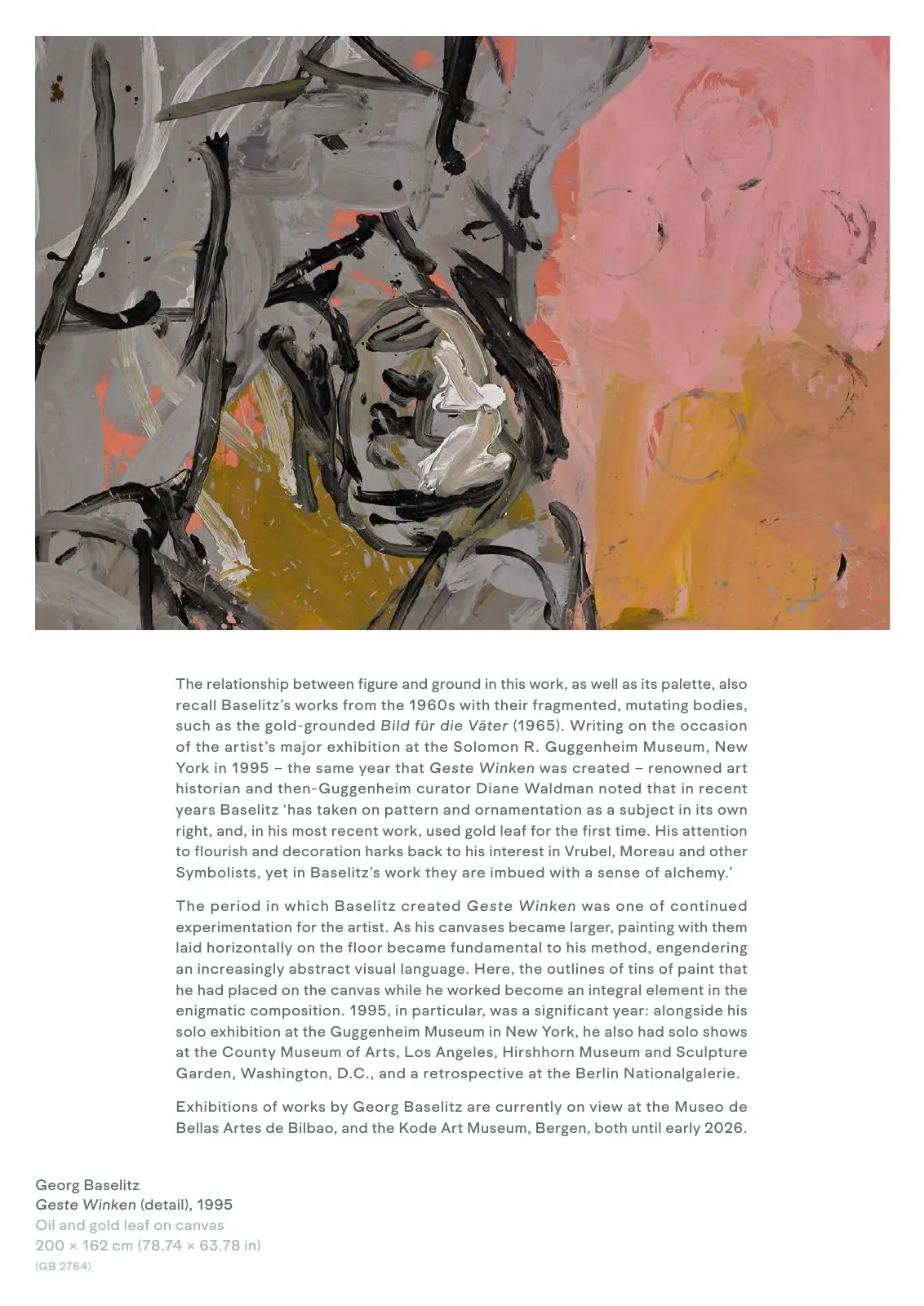
The relationship between figure and ground in this work, as well as its palette, also recall Baselitz’s works from the 1960s with their fragmented, mutating bodies, such as the gold-grounded Bild für die Väter (1965). Writing on the occasion of the artist’s major exhibition at the Solomon R. Guggenheim Museum, New York in 1995 – the same year that Geste Winken was created – renowned art historian and then-Guggenheim curator Diane Waldman noted that in recent years Baselitz ‘has taken on pattern and ornamentation as a subject in its own right, and, in his most recent work, used gold leaf for the first time. His attention to flourish and decoration harks back to his interest in Vrubel, Moreau and other Symbolists, yet in Baselitz’s work they are imbued with a sense of alchemy.’ The period in which Baselitz created Geste Winken was one of continued experimentation for the artist. As his canvases became larger, painting with them laid horizontally on the floor became fundamental to his method, engendering an increasingly abstract visual language. Here, the outlines of tins of paint that he had placed on the canvas while he worked become an integral element in the enigmatic composition. 1995, in particular, was a significant year: alongside his solo exhibition at the Guggenheim Museum in New York, he also had solo shows at the County Museum of Arts, Los Angeles, Hirshhorn Museum and Sculpture Garden, Washington, D.C., and a retrospective at the Berlin Nationalgalerie. Exhibitions of works by Georg Baselitz are currently on view at the Museo de Bellas Artes de Bilbao, and the Kode Art Museum, Bergen, both until early 2026. Georg Baselitz Geste Winken (detail), 1995 Oil and gold leaf on canvas 200 × 162 cm (78.74 × 63.78 in) (GB 2764)
正文与记录 · 第 18 页
his work between the artist’s hand and the mechanically reproduced image. The work also incorporates Rauschenberg’s own 35mm colour slide photographs. By the mid-1980s, Rauschenberg was silkscreening his black-and-white photographs onto a variety of supports, but his Clayworks are the earliest instance of his inclusion of his own colour photography. Rauschenberg had previously incorporated icons from the Western art histor - ical canon as early as his Combines and silkscreen paintings from the 1950s and 1960s, both as an act of homage to great works of art history and as an invitation to the viewer to revisit their own relationship to these works: part Robert Rauschenberg Able Was I Ere I Saw Elba (detail), 1983 Transfer and glaze on high-fired ceramic 270.3 × 231.1 cm (106.42 × 90.98 in) (RR 1308)
正文与记录 · 第 25 页
Georg Baselitz Vor Indigenen waren schon andere da (detail), 2025 Oil on canvas 300 × 240 cm (118.11 × 94.49 in) (GB 2913) In Vor Indigenen waren schon andere da (2025), Georg Baselitz depicts the pallid, inverted figure of his wife, Elke, suspended amid the pitch-dark pictorial space. She floats to the fore beside the skeletal contour of a slanted bed - frame that harks back to her hospital bed in Baselitz’s Wagon-lit mit Eisenbett (2019), in the collection of the Centre Pompidou, Paris. The artist relentlessly revisits motifs from his own celebrated oeuvre to experiment with new formal developments. In his most recent body of work, Baselitz, who paints with his canvas on the floor, ploughs the wheels of his walking frame through the still- wet paint to leave a network of expressive striations that encircle the figure. The destructive yet unifying lines become wrinkles or scars on the canvas: as Bernard Blistène writes, ‘as if one hand has destroyed what the other has built’. This unconventional technique is at once a playful, ironic nod to the effects of ageing on Baselitz’s practice, and a remarkable transformation of such ob - stacles into opportunities for renewal. Demonstrating this novel mark-making technique, which becomes a compositional element, this painting bears witness to the artist’s unrelenting impulse to experiment.
正文与记录 · 第 32 页
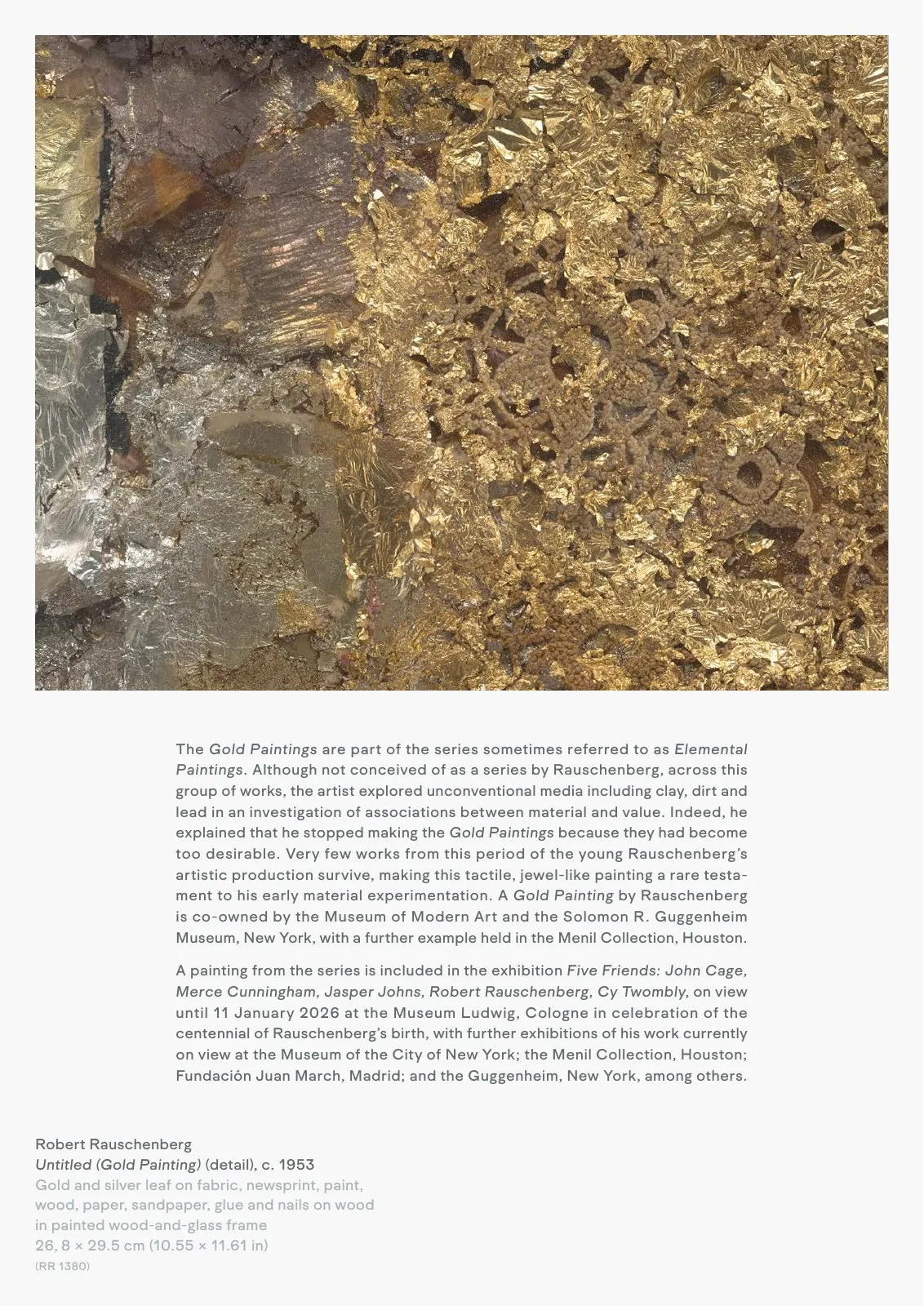
The Gold Paintings are part of the series sometimes referred to as Elemental Paintings . Although not conceived of as a series by Rauschenberg, across this group of works, the artist explored unconventional media including clay, dirt and lead in an investigation of associations between material and value. Indeed, he explained that he stopped making the Gold Paintings because they had become too desirable. Very few works from this period of the young Rauschenberg ’s artistic production survive, making this tactile, jewel-like painting a rare testa - ment to his early material experimentation. A Gold Painting by Rauschenberg is co-owned by the Museum of Modern Art and the Solomon R. Guggenheim Museum, New York, with a further example held in the Menil Collection, Houston. A painting from the series is included in the exhibition Five Friends: John Cage, Merce Cunningham, Jasper Johns, Robert Rauschenberg, Cy Twombly , on view until 11 January 2026 at the Museum Ludwig, Cologne in celebration of the centennial of Rauschenberg’s birth, with further exhibitions of his work currently on view at the Museum of the City of New York; the Menil Collection, Houston; Fundación Juan March, Madrid; and the Guggenheim, New York, among others. Robert Rauschenberg Untitled (Gold Painting) (detail), c. 1953 Gold and silver leaf on fabric, newsprint, paint, wood, paper, sandpaper, glue and nails on wood in painted wood-and-glass frame 26, 8 × 29.5 cm (10.55 × 11.61 in) (RR 1380)
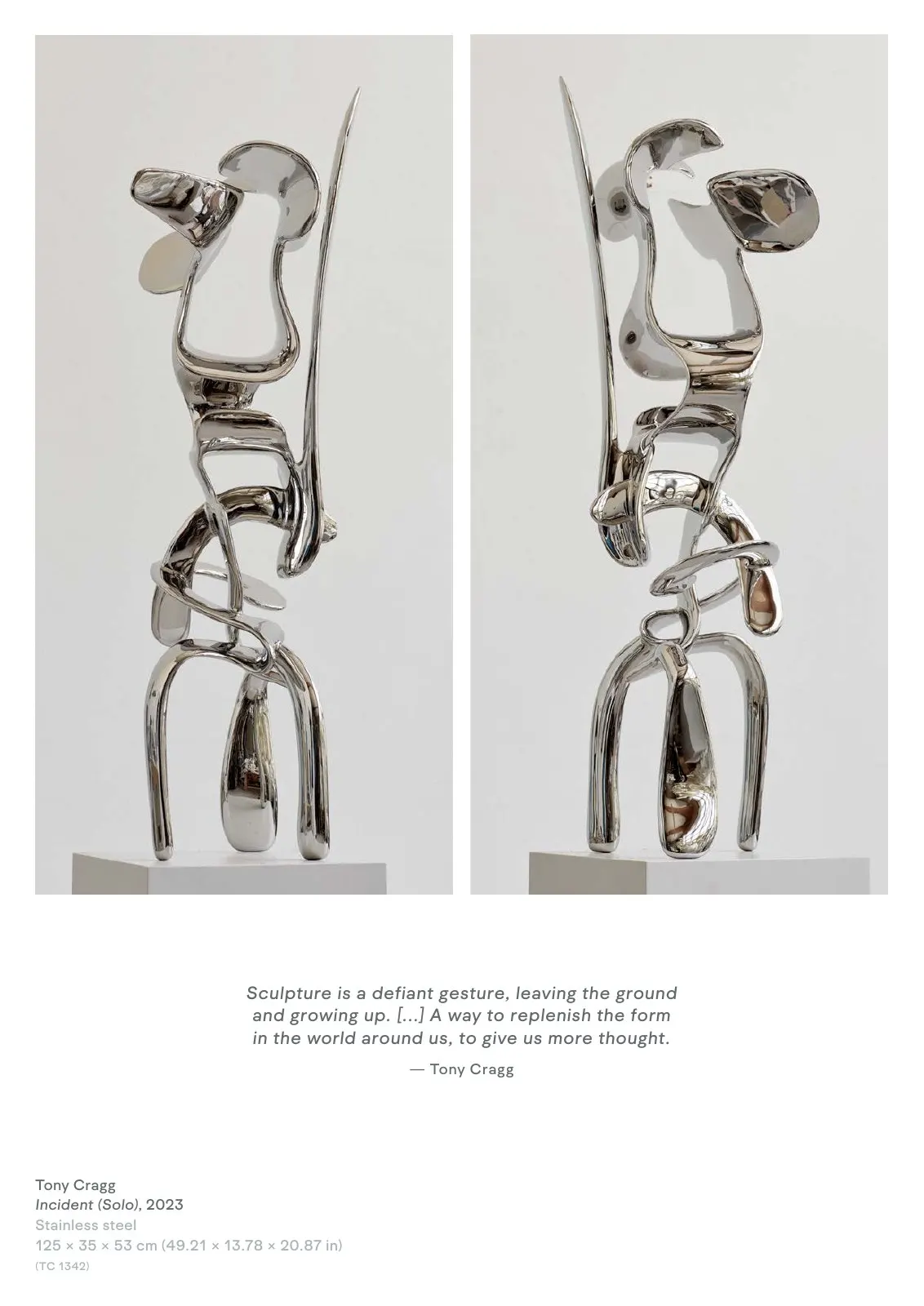
正文与记录 · 第 40 页
Emilio Vedova Per la Spagna, 1962 Oil on canvas 145 × 200 cm (57.09 × 78, 74 in) (EMV 1215) With its masterful chiaroscuro and teeming composition, this painting is a re - markably resolved example of Vedova’s mature work. His gestural black-and- white brushwork brims with a palpable turbulence, accentuated by bursts of colour in visceral red and vivid yellow. Amid this explosive tangle of strokes and drips, finer black marks cluster into indecipherable letters, like muffled cries struggling to burst forth from the canvas, while the whites that occupy the spaces between them flood the composition with an alluring luminosity, testifying to Vedova’s enduring sensitivity to light. The vital force that pulsates within the painting draws in and galvanises the viewer, epitomising the unique power of Vedova’s abstract language to embody his unyielding political engage - ment. In the artist’s own words, ‘Painting today means living today, debating the problems of today.’ An exhibition bringing Vedova’s work into dialogue with that of another great Venetian painter, Tintoretto, is currently on view at Palazzo Madama, Turin until January 2026.
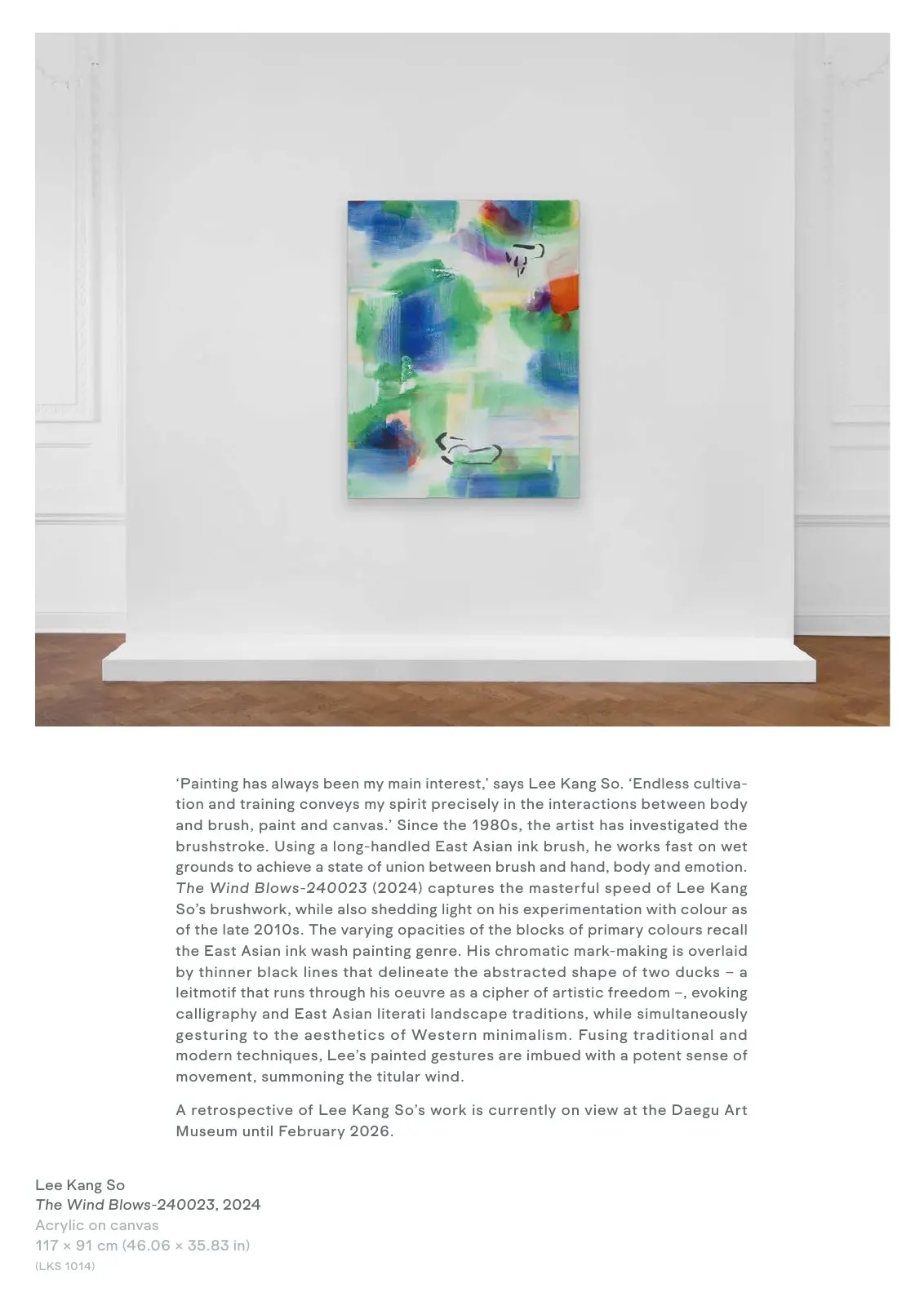
正文与记录 · 第 47 页
Martha Jungwirth Untitled, 2025 Oil on paper on canvas 241.2 × 92 cm (94.96 × 36.22 in) (MJ 1534)
正文与记录 · 第 58 页
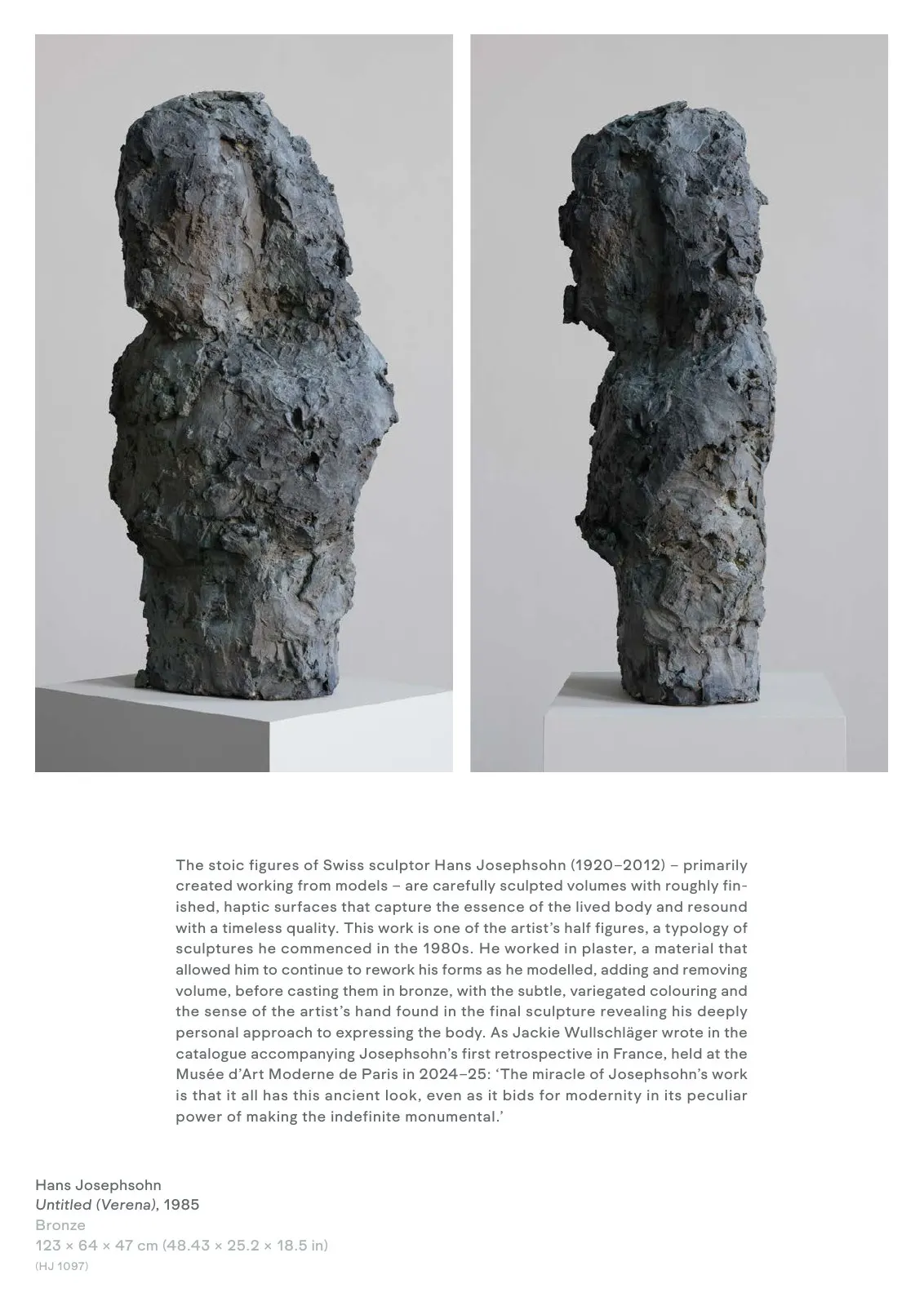
Oscillating between utopia and dystopia, Jules de Balincourt’s paintings explore ever-changing landscapes – both physical and psychological. He begins his paintings without a set plan, working intuitively through abstractions that gradually resolve into recognisable forms – a process he describes as ‘a dance in the dark’. Often disguising complex social commentary in seemingly innocuous compositions, his paintings reveal details that undermine or complicate the apparent narrative. In Hidden in the Shadows of the Night (2025), a line of rippling trees on the far side of a clearing, painted in the fine detail characteristic of the artist’s hand, seem to fall away into shadows in luxuriant shades of indigo and green. As people come and go from between the willowy fronds, the fabric of the landscape seems to be washing away before us, warping languidly into a representation of imaginative time and space in a reminder that we also inhabit inner worlds. Jules de Balincourt Hidden in the Shadows of the Night , 2025 Oil and oil stick on panel 177.8 × 203.2 cm (70 × 80 in) (JDB 2137)
正文与记录 · 第 65 页
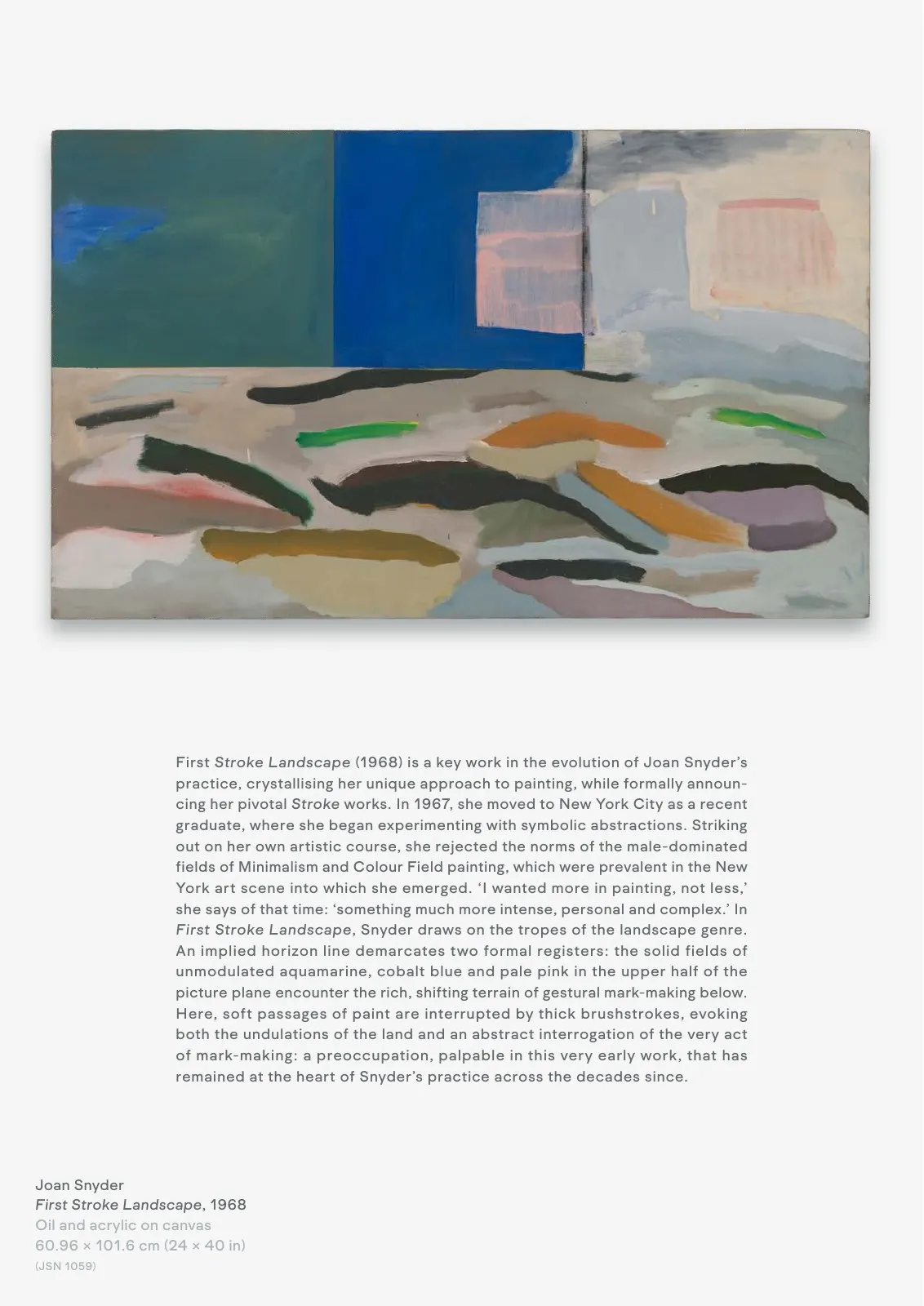
Alex Katz Ada in the Dark, 2000 Oil on canvas 122 × 183 cm (48.03 × 72.05 in) (AKZ 2525) In this work from 2000, Alex Katz depicts Ada’s bust, cinematically cropped against a pitch-dark ground. Likening her face to that of Dora Maar’s, Picasso’s unmistakable muse, Katz has been portraying Ada since they first met in 1957. As art critic Lawrence Alloway observes, Katz’s early renditions of Ada were worked directly on the canvas, exuding candour and spontaneity, while later and increasingly large works concealed the traces of their execution beneath smooth planes of colour, as in the present painting. The passage of time is revealed by the grey streaks that adorn her raven mane, yet Ada is abidingly composed, staring back at the viewer with graceful gravitas; for curator Robert Storr, ‘Ada’s face matures gradually into an almost regal aplomb and authority’. Reflecting on her musedom, Storr continues: ‘How little we know about her after all. That is her job. To keep us guessing, to forestall the consummation of reciprocal recognition, in short to captivate by simply, imperturbably being there. We – the viewers – enter into this compact of infinitely deferred intimacy without hesitation.’
正文与记录 · 第 72 页
Liza Lou Anaphora (detail), 2025 Oil paint and glass beads on stretched canvas 129.5 × 132.1 cm (51 × 52 in) (LL 1221) Anaphora (2025) belongs to Liza Lou’s new body of work in which she renders painterly gestures redolent of mid-century American abstraction in her signa - ture medium: tiny, refractive glass beads. Superimposing the brightly coloured beads upon gestural strokes of oil paint, Lou layers two different temporalities on a single canvas: the painstaking meditation of beadwork contrasting compel - lingly with the vigorous impulsivity of the brushstroke. The beads magnify each stroke, slowing down its spontaneity and lending the canvas a teeming, haptic aspect. ‘The work is about amplification, it’s about making things more ideal,’ says Lou. ‘Beads are a way to bring something further into view; they make more of things. There’s that poem by Pessoa where he writes about wanting flowers to be more flowers than flowers, and in this body of work I’m trying to make the heroics of painting even more heroic. I’m using beads as a way to make paint more paint than paint.’ The title of the work, Anaphora , refers to a rhetorical device whereby repetition is used to emphatic effect, evoking Lou’s accentuation of each brushstroke through a focused reiteration of its every splatter and drip in beads.
正文与记录 · 第 80 页
Tom Sachs Standing Woman, 2025 Enamel and ferric nitrate patina on silicone bronze with stainless steel hardware 139.7 × 38.1 × 52.1 cm (55 × 15 × 20.5 in) (TSA 1540) Picasso: the word is synonymous with art. For years, I’ve studied so many systems. McDonald’s, architecture of Le Corbusier and the Bauhaus, military-industrial systems. For me, it was a way of trying to understand Picasso the way I would understand a battleship or a skyscraper. To understand how something is made. So, working with Picassos and understanding them is a way of taking them apart. — Tom Sachs A Good Shelf, an exhibition and interactive installation by Tom Sachs that marries his signature bricolage sculpture techniques with his ceramic practice, is on view at Thaddaeus Ropac London until 20 December 2025.
正文与记录 · 第 88 页
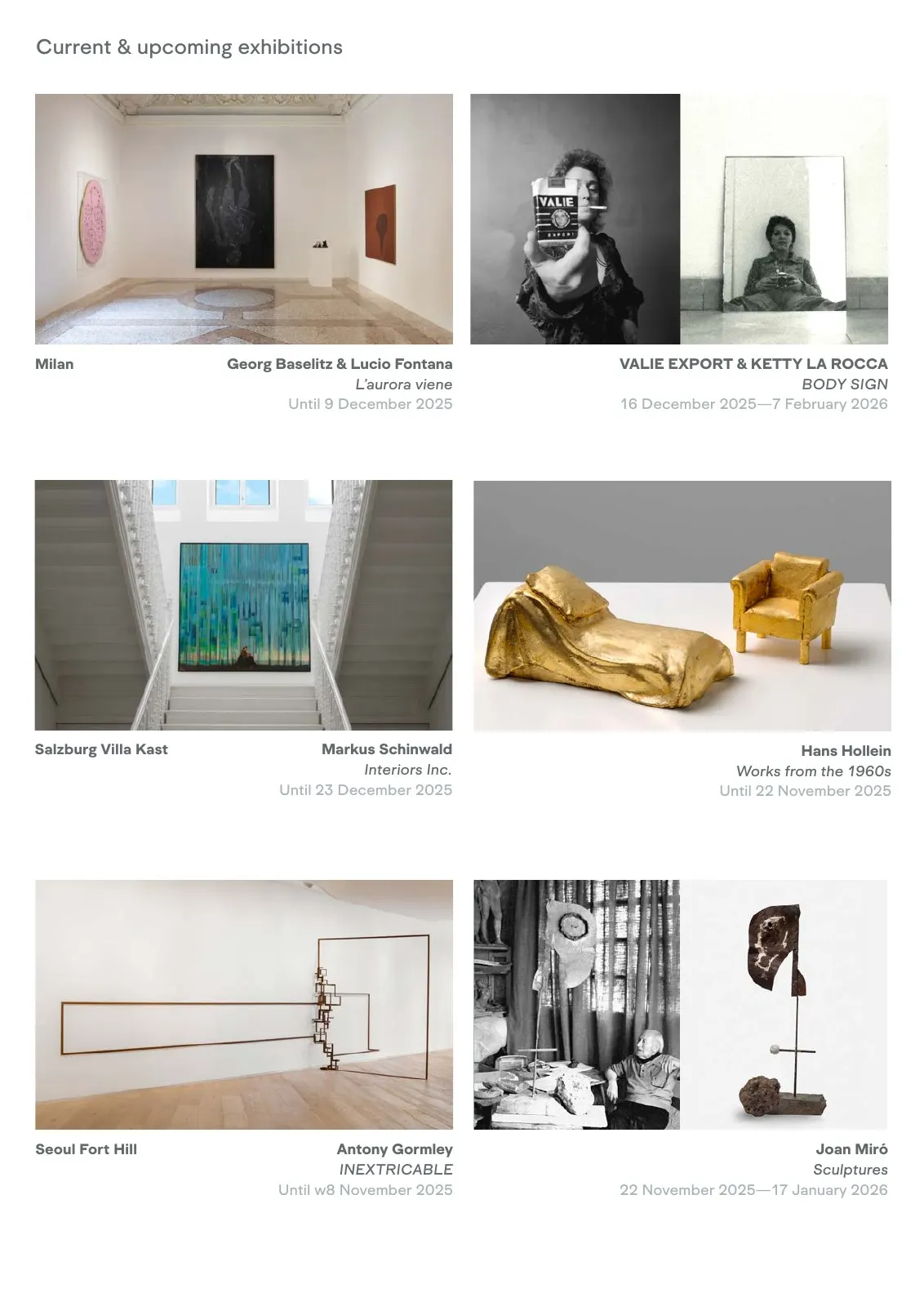
Current & upcoming exhibitions Milan Georg Baselitz & Lucio Fontana L’aurora viene Until 9 December 2025 VALIE EXPORT & KETTY LA ROCCA BODY SIGN 16 December 2025—7 February 2026 Seoul Fort Hill Antony Gormley INEXTRICABLE Until w8 November 2025 Joan Miró Sculptures 22 November 2025—17 January 2026 Markus Schinwald Interiors Inc. Until 23 December 2025 Salzburg Villa Kast Hans Hollein Works from the 1960s Until 22 November 2025