Jennifer Guidi | Info PDF | David Kordansky Gallery
正文与记录 · 第 1 页
JENNIFER GUIDI [邮箱已省略] [网址已省略] T: 323.935.3030
正文与记录 · 第 17 页
Jennifer Guidi Sun In Gemini (Universe Mandala SF #2G, Yellow, Black Sand), 2017 sand, acrylic, and oil on linen 116 x 98 x 2 inches (294.6 x 248.9 x 5.1 cm)
正文与记录 · 第 28 页
[邮箱已省略] [网址已省略] T: 323.935.3030 SELECTED EXHIBITIONS
正文与记录 · 第 38 页
Jennifer Guidi, In the Heart of the Sun, David Kordansky Gallery, Los Angeles, November 5 – December 17, 2022
正文与记录 · 第 48 页
Jennifer Guidi, Visible Light / Luce Visibile, Museo d’Arte Contemporanea di Villa Croce, Genoa, July 1 – September 24, 2017
正文与记录 · 第 58 页
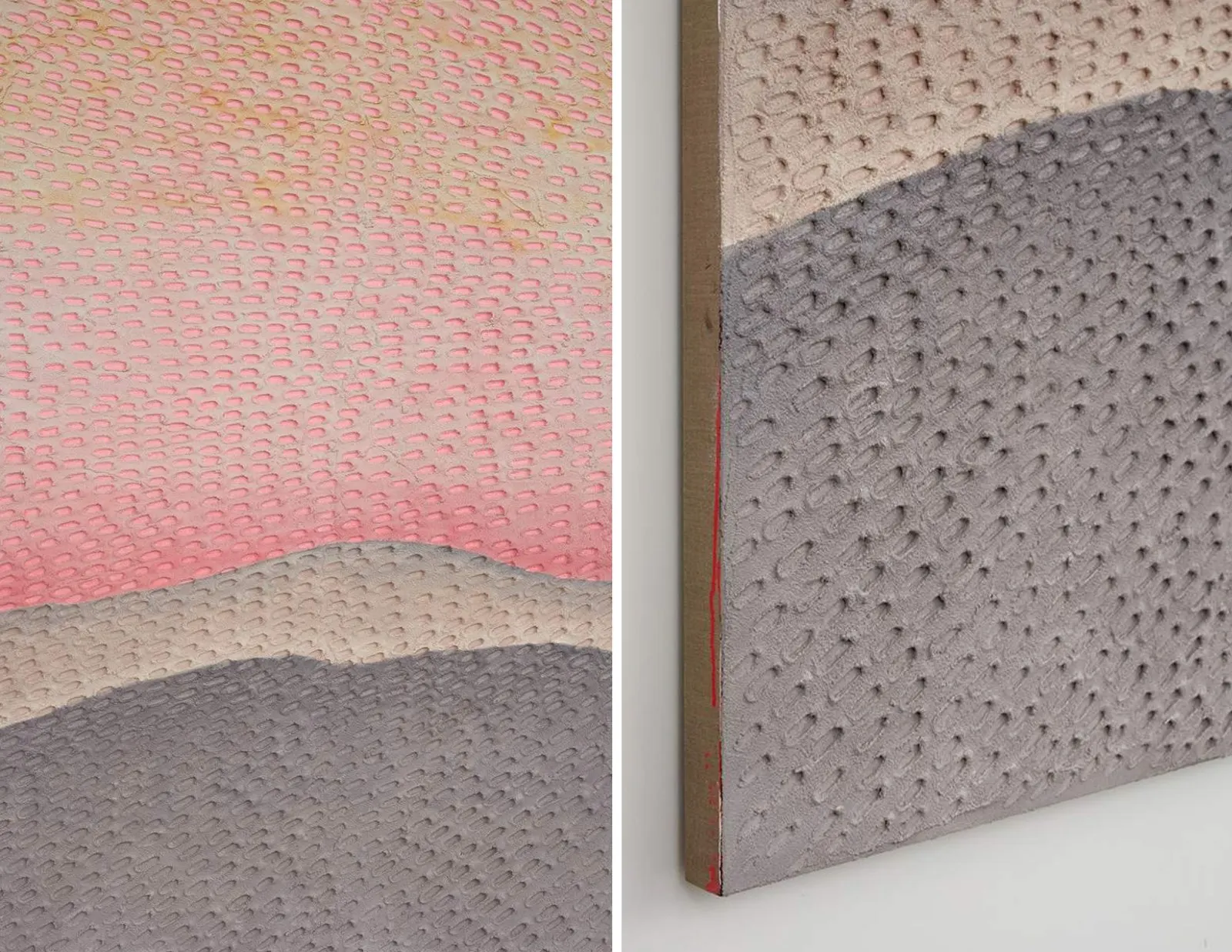
Rees, Lucy, “Jennifer Guidi’s Meditative New Show Explores the Beauty of Nature at Château La Coste in Provence,” GalerieMagazine.com, August 4, 2023 An installation view of Jennifer Guidi’s show at Chateau La Coste. PHOTO: FRÉDÉRIC DESIMONI. COURTESY OF CHÂTEAU LA COSTE your eye is automatically drawn to. I do something similar in my paintings where I use color to draw you in.” Along the adjacent walls are a series of smaller mountainscapes, somewhat re- sembling small windows, encouraging the viewer to take a closer look. These vignettes are a bold combination of psychedelic color, form, and texture. Inspired by California’s rocky terrain and crafted in Guidi’s massive studio in Los Angeles, these new works equally recall the lines and contours of Provence’s landscape. “The mountains here are magical,” continues the artist, who suggests the motif represents a place of contemplation and reflection, a physical representation of a spiritual path to a higher consciousness. “Coming here for the first time and experiencing it in person has been incredible. It’s been amazing to introduce my paintings into this landscape.” At its heart, “Mountain Range” is a celebration of that unique “painters’ light” that has long lured artists in both destinations. “When I was thinking about the landscape of Provence, the fields of lavender, I was thinking about color and light. There is such a layering that adds up to the rolling hills,” Guidi says. “It was something that really pushed me to explore a building up of color and surface. I was also thinking about the Impressionists and the Pointillists. I am inspired by artists who have come to this region whether it be Van Gogh, Matisse, Cezanne. These are artists I have looked at for over 30 years.”
正文与记录 · 第 67 页
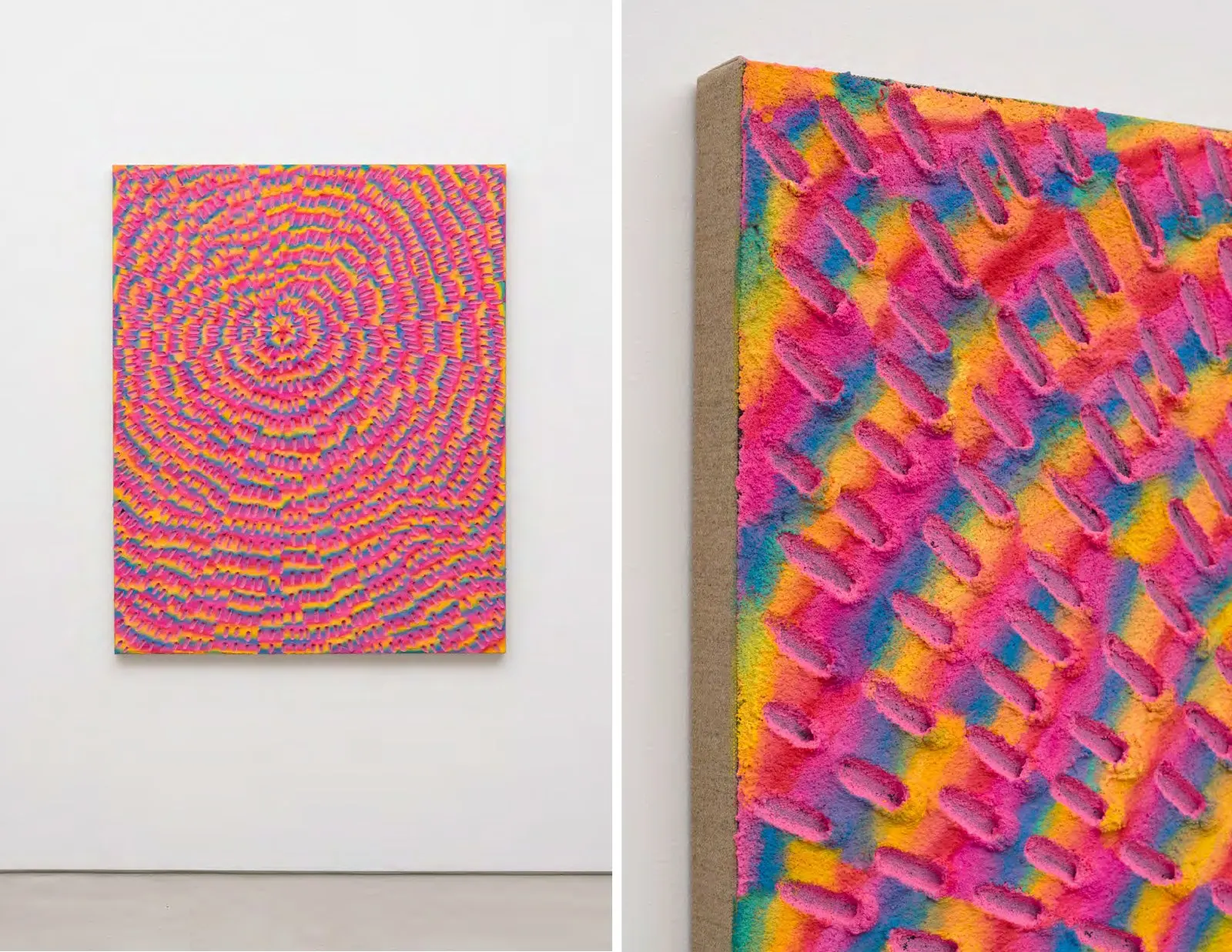
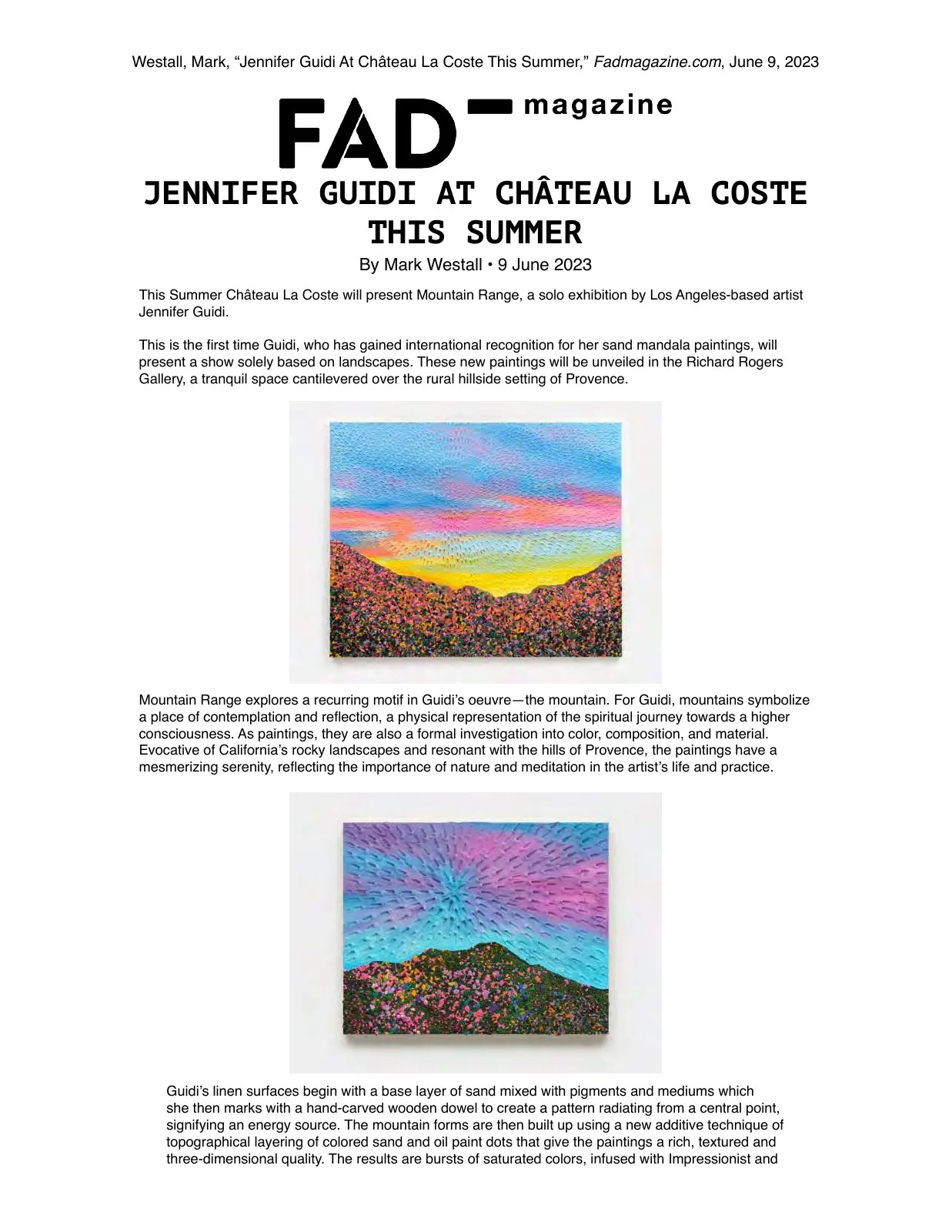
Westall, Mark, “Jennifer Guidi At Château La Coste This Summer,” Fadmagazine.com, June 9, 2023 JENNIFER GUIDI AT CHÂTEAU LA COSTE THIS SUMMER By Mark Westall • 9 June 2023 This Summer Château La Coste will present Mountain Range, a solo exhibition by Los Angeles-based artist Jennifer Guidi. This is the first time Guidi, who has gained international recognition for her sand mandala paintings, will present a show solely based on landscapes. These new paintings will be unveiled in the Richard Rogers Gallery, a tranquil space cantilevered over the rural hillside setting of Provence. Mountain Range explores a recurring motif in Guidi’s oeuvre—the mountain. For Guidi, mountains symbolize a place of contemplation and reflection, a physical representation of the spiritual journey towards a higher consciousness. As paintings, they are also a formal investigation into color, composition, and material. Evocative of California’s rocky landscapes and resonant with the hills of Provence, the paintings have a mesmerizing serenity, reflecting the importance of nature and meditation in the artist’s life and practice. Guidi’s linen surfaces begin with a base layer of sand mixed with pigments and mediums which she then marks with a hand-carved wooden dowel to create a pattern radiating from a central point, signifying an energy source. The mountain forms are then built up using a new additive technique of topographical layering of colored sand and oil paint dots that give the paintings a rich, textured and three-dimensional quality. The results are bursts of saturated colors, infused with Impressionist and
正文与记录 · 第 77 页
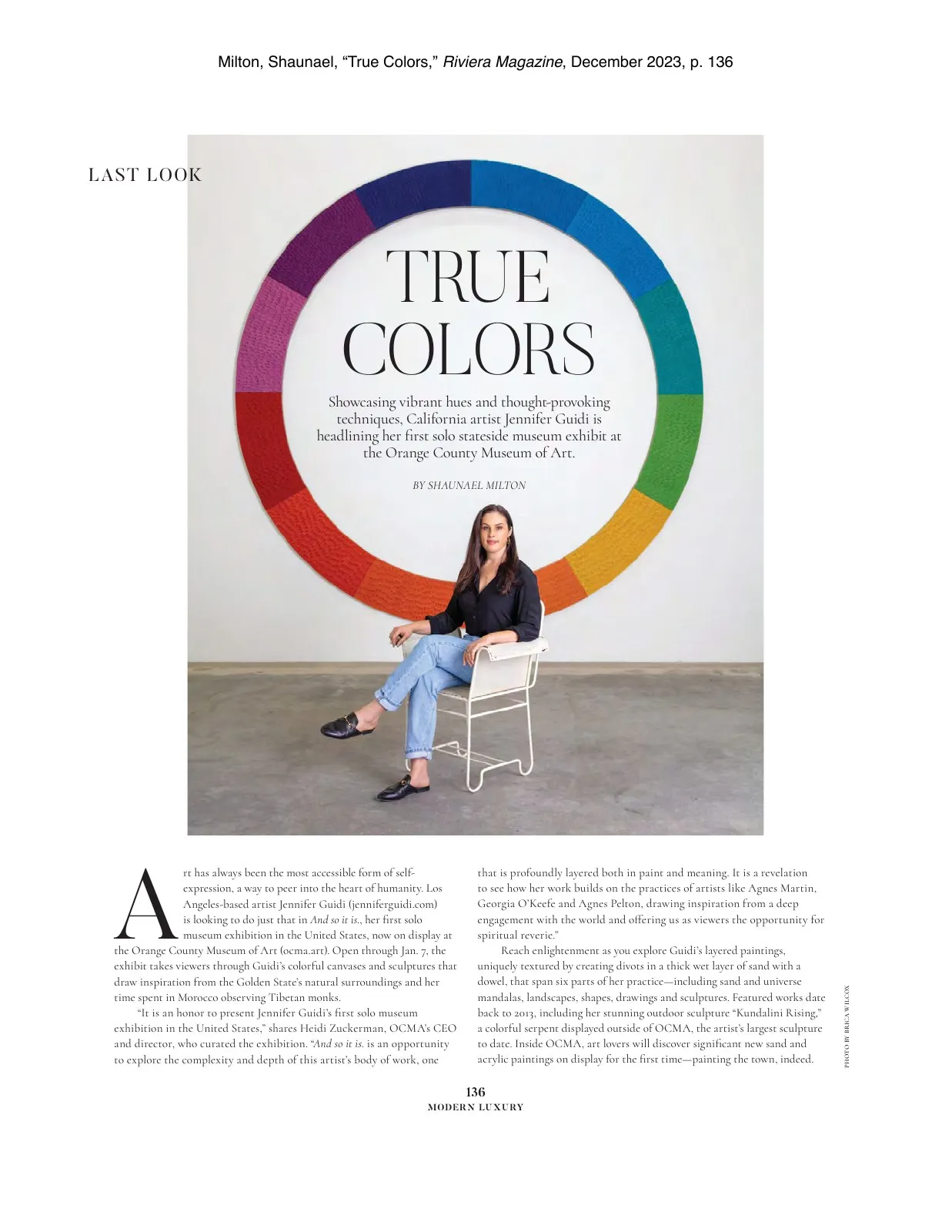
Pogrebin, Robin, “Where the Sky Meets the Sea: Jennifer Guidi Leans Into Beauty,” NYTimes.com, November 4, 2022 The acceleration in the artist’s career coincides with the development of Guidi’s spiritual practice and her move from representational to abstract painting. Inspired by the stitching on the backs of Moroccan carpets and Tibetan monks’ mandalas — where patterns radiate out from one central point — Guidi about a decade ago began mixing sand with paint. She also engages in chromatic explorations (lately moving into fluorescent pinks, blues and yellows) and studies chakra techniques that connect to the body’s energy centers. “I’m thinking of color as a way to connect — a way to engage — that invites people into a sense of aliveness,” Guidi said. “More colors. More dots. More energy. More vibrant. More vibration.” She meditates every morning and collects crystals, influences that give her paintings a mesmerizing tran- quillity that have caught the attention of collectors and curators. Several major institutions have acquired Guidi’s work, including the Hammer Museum, the Dallas Art Museum and the San Francisco Museum of Modern Art. “She’s an important part of the L.A. art scene,” said the collector Susan Gersh, who with her husband David bought Guidi’s “Pink Sky Mountain” in 2017. “It’s very ethereal looking, very romantic. At dif- ferent times of day, the colors change.” “Energy Amplified,” 2022. The new show is the first time Guidi is showing a large body of sculptures. via Jennifer Guidi and David Kordansky Gallery
正文与记录 · 第 87 页
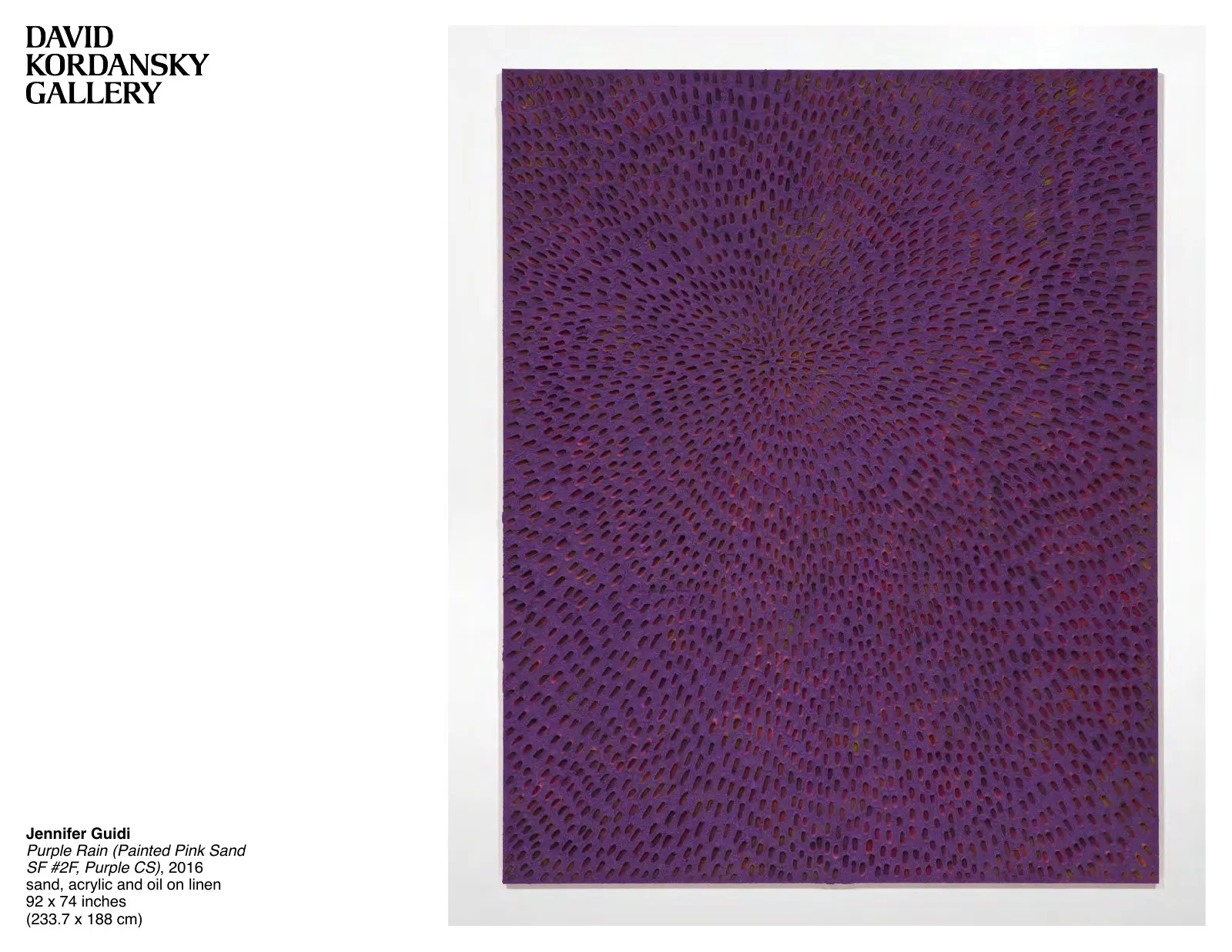
Mellin, Haley, “In Conversation with Jennifer Guidi,” Garage.Vice.com, February 28, 2020 several rugs, that I finally moved into abstraction. I was attracted to the thick stitches and unintentional patterns of their underside. I began working on a series of small paintings on paper from the photographs I had taken of sections of the rugs. The repetitive motion of painting the stitches resonated with me, leading me to a much larger body of work. These paintings opened up a new way for me to communicate through mark-making that was more connected to a personal, internal, and meditative form of expression. I was reading about how sand comes from the weathering of rocks over millions of years. It is a physical object, and it is a representation of time passing. You are combining a natural element, sand, with an art-historical element, painting. When did you start using sand in the paintings? Before I moved into abstraction, combining sand and paint was something I had thought about often. I was drawn to paintings that incorporated sand as a material. I remember seeing artwork by Dubuffet, Kandinsky, Burri, Braque, and Picasso, all who used sand at some point. There was something about the physicality of the texture on canvas that stuck with me. In 2011, I started another series of plants against stucco walls, but this time I made my backgrounds textured by mixing sand in the oil paint. In the summer of 2013, as soon as I returned from my annual family vacation in Hanalei, Kauai, I began making solid sand paintings with marks from sticks that I had found on the beach. Those were my first abstract sand paintings. You shifted from compositions with a horizon line, where the marks were reiterating the flatness of the canvas to where the marks are coming from a central focal point and expanding out toward the viewer. That is a profound move. How did you come to that? Moving from left to right, across and down, became unsatisfying. I wanted the work to have more movement, so I tried a few where the marks were expressive and varied in shape and size, but that was too random and didn’t activate the surface or draw in the viewer in the way that I was searching for. While watching Tibetan monks make a sand mandala, I was struck by the ritual of how they start in the center, work outwards, and, once finished, sweep the sand from the outer edge back into the center. Shortly after, I was facing a canvas as though it was a mirror and thought, “What if I start where I feel my heart would be reflected?” I followed my intuition and made the first mark up and a little to the left. That was my center. This is when I felt that the work had a definite energy source, where it created a vibration moving in and out. I appreciate how you integrate elements taken from the natural world with the human-invented space of art. I like these two worlds, nonhuman and human, colliding in a surface. What artists do you feel connected to? I enjoy looking at Agnes Martin, Georgia O’Keeffe, and Hilma af Klint. When I was making my first abstract paintings, I would have moments of doubt. Around that time, I remember watching a documentary on Agnes Martin and she said, “Stop overthinking it. Make it and keep making it. It doesn’t have to be such a big deal. You just need to want it and not change your mind.” I thought, “She’s right. Make it.” “Lunar Eclipse/Blue Moon (Painted Lavender Sand SF #1T, Blue Gradient, Lavender Ground),” 2018, sand, acryl- ic and oil on linen, courtesy of the artist
正文与记录 · 第 97 页
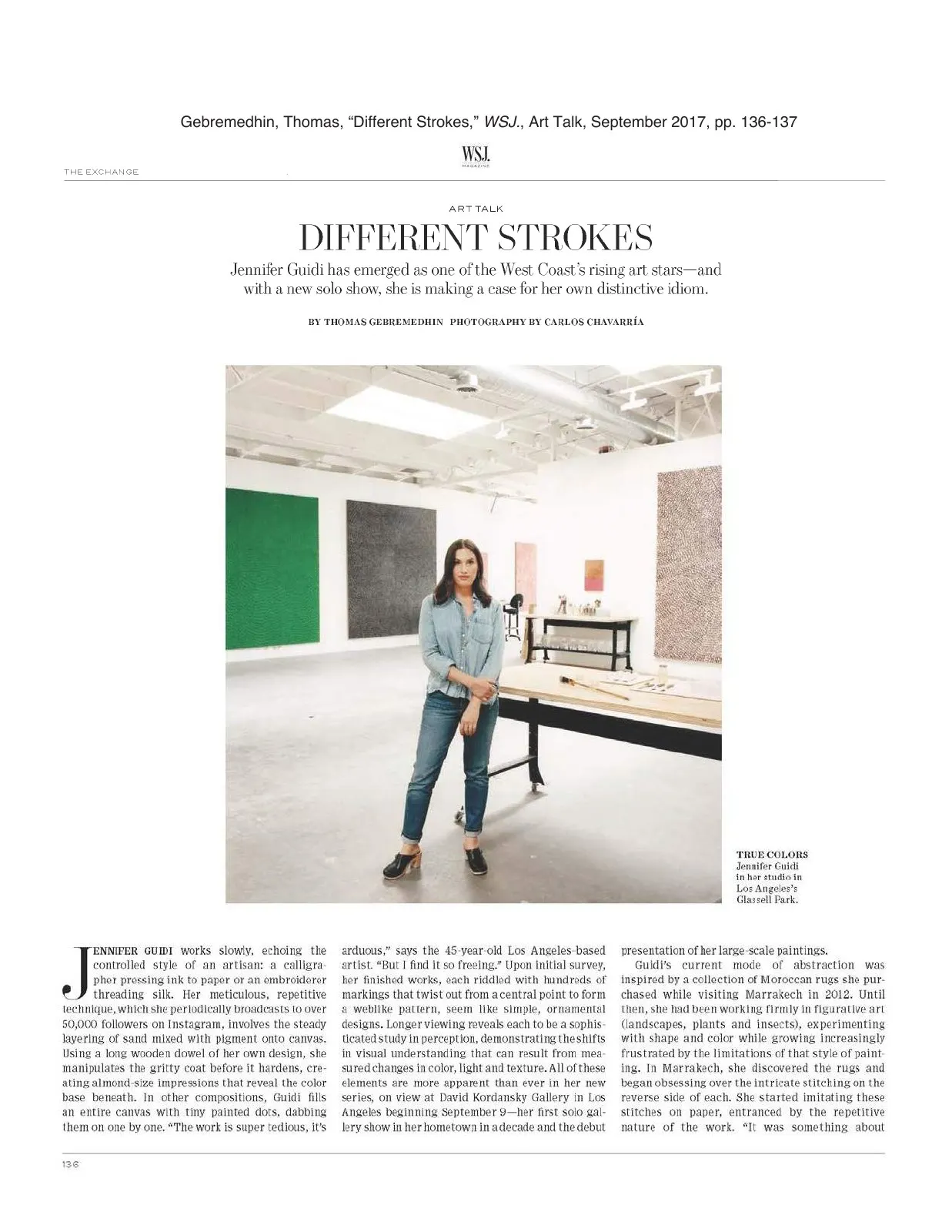
Gebremedhin, Thomas, “Different Strokes,” WSJ., Art Talk, September 2017, pp. 136-137
正文与记录 · 第 106 页
Mizota, Sharon, “Jennifer Guidi’s paintings at LAXART conjure Zen, summer vibes,” LATimes.com, May 30, 2014 Review Jennifer Guidi’s paintings at LAXART conjure Zen, summer vibes By Sharon Mizota Covered in irregular patterns of dots, Jennifer Guidi’s paintings at LAXART are charming records of a mind’s wander- ings. Slightly smaller than human scale, they fill the walls of the space’s smaller gallery with calm, flat tones of black, brown, beige and white. They seem wholly unremarkable, perhaps even boring, until you notice they are made from sand. Spread over the entire surface of an image, the light brown granules have been pushed into hundreds of tiny depressions that reveal a black ground underneath. These “dots” are aligned in undisciplined horizontal rows as if the artist had set out to make a straight line, but got lost somewhere along the way. The exhibition also features three similar paintings in oil. They are chromatically the reverse of the sand images, with wavy rows of light-colored dots on black. Perhaps it’s because here the dots are brush strokes on canvas that they feel both more forced and more expected. All of the works were initially inspired by the grid-like patterns of weaving, but the sand paintings in particular possess a meditative quality reminiscent of Zen rock gardens. They also evoke the outdoors and the immediate, tactile pleasure of dragging fingers through cool sand. In their own understated way, they feel perfect for summer.
正文与记录 · 第 116 页
[邮箱已省略] [网址已省略] T: 323.935.3030 F: 323.935.3031 December 22, 2016 Hartman, Stephanie, “36 brilliant things to do in London this week,” TimeOut.com, December 5, 2016 Chiaverina, John, “Planned Parenthood Benefit Sexy Beast Announces 2016 Artist Lineup,” ArtNews.com, July 12, [电话已省略] Meeks, Rachel, “Vibrant Views of Kabul: Artists’ Rugs at the Hammer Museum, LA,” COVER Magazine, Issue 40, 2015 Steadman, Ryan, “The Must Be Scene: 10 NY Art Shows to Catch This Fall,” Observer.com, September 9, 2015 “Artists’ rugs at the Hammer Museum, LA,” Cover-Magazine.com, July 31, [电话已省略] Pechman, Alexandra, “Jennifer Guidi: Star Material,” WMagazine.com, December 4, 2014 Korek, Bettina, “SERIOUSLY GO: Jennifer Guidi at LAXART,” Huffingtonpost.com, June 16, 2014 Mizota, Sharon, “Review: Jennifer Guidi’s paintings at LAXART conjure Zen, summer vibes,” LAtimes.com, May 30, 2014 Small, Rachel, “Pattern System,” InterviewMagazine.com, Art, May 21, 2014 Korek, Bettina, “Fiber Arts: Jen Guidi Talks Working in Rugs, Sand, and Instagram,” Style.com, April 25, [电话已省略] Knight, Christopher, “The ordinary in colorful splendor,” Los Angeles Times, Art Reviews, January 21, 2005, p. E25